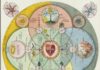
In this blog post Samuel Robinson and Mathieu (Mat) Ravignat talk about Mat’s new book “The Way of the Rose-Croix” and share their comparison of French vs. German vs. Anglo-Saxon Rosicrucianism, along with some of their views on the current status of the tradition.
Sam: What are your intentions in publishing all of this material?
Mat: First of all, thanks for the interview, Sam and the opportunity to talk about my new book. I truly admire the work you are doing in bringing the entire worldwide Rosicrucian community together and this in a way that encourages debate and questioning established ideas so that we can all find the truth of our beloved traditions together. Thanks very much for your efforts!
To answer your question, I would say, that the intentions of writing this book are the same for all my books, to let the Masters of the French Esoteric Tradition speak for themselves by translating them so that their original intentions and traditional teachings-practices may be better known, and secondly to extract from their works the spiritual practices they recommended so that they can actually be used today.
But perhaps my answer might be clearer if I address what I mean by ‘traditional.’ By this I don’t mean anything Guénonian or Evolian but rather teachings and practices which are less-affected by three major trends found later in western esotericism after the late 19th century to 21st century: syncreticism, blavatskianism (and its child new-agism) and psychoanalysis (particularly jungianism). Don’t get me wrong I am not condemning these approaches, they are certainly valid for those who are spiritually attracted to them and need them, but it is hard to deny that in their own ways they have helped (intentionally or otherwise) obscure what pre-19th century western esotericism was all about (including its mysticism, theurgy, magnetism and alchemy). Personally, I think it is important to know how the pre-19th century Masters thought and taught before these modernist veils were placed on them, even if it is just to allow a comparison to be had between ‘old school esotericism’ and modern esotericism. Wouldn’t you agree?
Sam: Thanks Matt, I have read your work with fascination over the years, especially your work on Levi several times, that’s one of my top Rosicrucian books. I very much relate to your endeavours seeing that I too am working along similar lines but to allow the German Rosicrucian guides to speak for themselves, especially for the period of the 1800’s leading up to the arrival of Theosophy. Similar to your view, I try to share with others that today there’s a need to look at Rosicrucianism through the lens of pre-Blavatsky and post-Blavatsky eras. These two eras of Rosicrucianism are not the same. Post-Blavatsky, there’s a stronger tendency to see Rosicrucianism as an ancient tradition and the elements that make Rosicrucianism its own unique current is diminished in the process of making it more universal. The reformation elements get lost, as does its Christian mysticism. In fact, I noticed that those who have studied in post-Blavatsky systems, are often not capable of separating in their minds the difference between what they learnt about Rosicrucianism from those systems and how it was perceived prior to Blavatsky’s arrival. Similar to you, I wouldn’t say these systems are not valid, especially if they are helping people grow. However, I see those systems as a stepping stone to later discovering the core of Rosicrucianism, let us say an outer public vehicle to later reach the inner. I tend to think that the later more universal currents have lost the oomph older Rosicrucianism could give them. The writings of the older Rosicrucians are brilliant and later writers are a bit “meh” or missing something. I find the older materials not only more inspiring but also there’s a “dig in and dig deep” practical outlook, which goes far deeper than “sit and visualize” as is typical in modern methods. Would you agree there is a lack of practical materials in some Martinist or other orders and that your book might fill a gap for existing teachings out there?
Mat: I agree with you generally with regards to a lack of some practices is some orders, though I might put it more in this way: maybe it is not so much the lack of practices as a clear idea of spiritual progression. So, it is a pedagogical problem, and the quality of the teachings largely depends on the quality of the transmission and a lot of orders in their practices are just a mishmash of unrelated things, some in my opinion even put incompatible things together.
Also, and I address this a bit in my book but there is a lot of lineage glorification in esoteric orders as though somehow if one has lineage, one is suddenly more spiritual and has access to a better curriculum. This is actually often untrue, and one might have a quote unquote ‘good lineage’ and be given a terrible curriculum. Having lineage does not help one iota towards your spiritual progress unless it comes with a rigorous progressive curriculum of spiritual practices. It also doesn’t help if one uses it as an excuse to not do the work. I think in this way the obsessive importance placed on lineage in some esoteric circles today can fall into a kind of superstition and actually be an impediment to spiritual progress. Ultimately, I think the Spirit and the Angels respond to the sincerity of one’s personal efforts and work more than anything else. This is more important than ‘lineage’ or the minutiae of a magical formula. As though the Angels cannot read into our hearts!
I also think that many orders forget that they are about spiritual progress and frustration ensues since sincere seekers who truly want to progress spiritually are disappointed because they are not given the means to do so despite receiving fancy tittles and being in ‘ultra-secret magical’ orders. Promises are being made and not being kept though I think it is rarely the fault of the transmitters since they were simply given what they were given but sometimes I think some orders should come with a ‘not as advertised’ label.
As for my book, I think for those more spiritually attracted to the mystical-devotional way it might help in the sense that it translates many helpful traditional R+C practices that one could incorporate into one’s daily life to great effect. In my experience, these practices work towards the purification of the self and in increasing the feeling of the presence of God and his Holy Angels in one’s daily life. They also help to make one a better person.

Mat presents a French R.C image of Elias Artista
Sam: You’ve made many great points here. I’ve seen so many students quit spiritual systems of initiation which helped them so much once they found a few things lacking, or that some materials were missing. They do indeed blame the leaders I agree its very much the case that that’s what those spiritual leaders inherited too. Many are just trying their best. I also found that there needs to be more accountability for self-direction in esoteric studies. People need to study harder, look harder at what they have. Social Media has meant today’s students behave quite different than before. By that I mean so many esoteric students try to send questions every few days on Facebook, often seeking validation on very small issues. If they overdo it, I tend to tell them not to write me for one year. Some get upset of course, but it is not the role of an esoteric guide to babysit. Too much access is a bad thing. Going back to how I learnt things, we sent a letter or two per year to our favourite author. We got one or two letters back, maybe even a phone call once per year. We had to figure things out for ourselves. This kind of spiritual independence is very important, and it created stronger adepts, stronger Rosicrucians. It’s hard to emulate now that students have too much instant access today. What this means for those who encounter occult systems as you describe, which appear to be missing the teachings promised in those systems, is that I would hope that through spiritual independence each student discovers their own arcana, that is to say, their own higher system of regeneration. Of course, such a task takes real work, and this is where I think the practices you give will enable others to get there.
Sam: Did any of the French masters you report on promote a path of independent exploration (rather than working in secret occult orders) and even try to teach a path of self-initiation, and if so how?
Mat: I have not come by anything with regards to them agreeing with self-initiation since the idea of ‘apostolic lineage’ remained an important frame of mind for them, but certainly they believed and engaged in self-study. For example, the OKR+C prescribed subjects to be studied in each grade but the individual was left to develop their own interests and write on specific subjects that interested them. There is also an assumption that Mastery or Adepthood led to self-reliance as well.
With regards to working outside of an Order this happened a lot until the OKR+C was formed. I would say it was even the norm in the French R+C tradition where the individualized student-disciple relationship was the primary one until the later half of the 19th century. For example, Lévi had several one on one students, and his teaching was by letter and through the occasional visit to Paris when the student could get there. There is also no solid evidence of a non-masonic R+C ‘Order’ existing in Toulouse either and it also appears that the Polish-Prussian Messianists in France taught on a one on one basis as well.
Sam: Something I’ve always wanted to ask you Mat, how would you describe the spirit of French Rosicrucianism vs. the German and Algo Saxon traditions? I’ve worked mainly with the German and the Algo-Saxon but hardly the French, where you’re the real expert there.
Mat: This is a tricky one as esotericists (many of them who were multi-lingual) have not limited their teaching and activities to one country and often perceived themselves as being part of a wider community. Also, before the 19th century many of the nations that we take for granted today (and the nationalisms that come with them) just did not exist. Modern Germany certainly did not, nor did Italy and most Central and Eastern European countries. I struggled with this distinction myself earlier in my writing because it is not very precise. For example, language and nation states often don’t match. Being Belgian and Canadian (both multi-national and multi-lingual countries) I am particularly sensitive to this. I speak French but my ancestors are not from France and so national labels are problematic. They also tend to divide people too conveniently when many of the Masters wanted to do the opposite. Because of this when I use the word French, I mean it more as the ‘French-language’ tradition, I guess in a similar way that Austrians would be part of the German-language tradition. With Great Britain one also has to be careful to distinguish the Welsh, Scottish, Northern-Irish and of course the English!
Having said that, I still think the use of language and geographical distinctions are still generally useful because it narrows the extent of the phenomenon we are dealing with and helps give the reader more clarity on what we are talking about but only if we don’t fall into vast generalizations and the typical prejudices of defining ‘national attitudes’ and a ‘national character.’ Like, the French are all ‘emotional’ and the Germans are all ‘rational’ kind of thing.
Ok with that caveat in mind I think I can now answer your question. I would say Rosicrucianism as expressed in France and in the French language, apart from its many similarities with other traditions in other countries and languages, has what I would characterize as a more Liturgical, Mystical and even Ecclesiastical flavour. In this way, and this despite the values of the French Revolution, it is perhaps less secularized than the German and English traditions though one has to be careful about making these kinds of generalisations. But certainly, there is a very high degree of overlap between nonconformist clerics and esoteric orders in France and particularly the Rose+Croix. For example,one can think of: Lévi who was a Deacon, Abbé Alta, Abbé Roca and of course the Abbé Julio. Also, high ranking members of the R+C felt it necessary to receive a kind of ecclesiastical ordination to perform some of their more advanced practices. Lastly, the fact that the French Esoteric Tradition created, unlike in other countries, its own esoteric churches like the Gnostic Church is also an indication of this phenomenon, I think.
Having said that it doesn’t take a lot of reading to realize that this more devotional and mystical approach is consistent with the original Rosicrucian current and texts related to it are full of prayers, confessions and invocations towards the Holy Trinity. Why this more devotional self-effacing approach has been jettisoned in many German and English modern esoteric schools is an interesting but complex question and I can’t pretend to have a full answer.
But again, this characterization of the French Rosicrucianism is a big generalization and there are plenty of ‘rationalist-securalist’ members and Masters in the past, so take it with a grain of salt please.

Mat presents Levi Tarot card private manuscript
Sam: Just to add to that, I do get the impression that there are a few differences between the German, Anglo-Saxon, and French. The main one here seems to be that in France, Rosicrucianism went hand in hand with Catholic systems, or Ecclesiastical, as you say. The German systems in the 1800’s still were very Protestant and pietistic, we don’t see liturgical rites or esoteric forms of the Catholic mass until a few later occult bodies in Germany adopted it from the French around 1910. Even then this died out. I also have a theory that the theurgy of the German Rosicrucians expired and went to France. By that I mean, systems like the angel magic of the Rosicrucians, such as invoking the 72 Shem-ha angels, those did exist in Germany, and a few during Mailander’s time still tried it. In the early 1900’s though, this all ended in Germany, their sole focus became internal alchemy, whereas it appears all those Rosicrucian angelical workings became a mainstay in France. You pointed out in your last book that Levi had a Polish-Prussian Rosicrucian teacher, which may explain how this exit of Rosicrucian angelic magic to France occurred.
Sam: Some forms of internal alchemy (arcana arcanorums) claim they work with eon guides or the 72 shemha angels. What is your perspective on the role of angelic magic for internal alchemy? Also, what is the purpose of working with them really?
Mat: It all depends on what one means about Internal Alchemy I guess. If by it we mean certain techniques that help purify the body and create a Body of Glory (also known as the Luminous Body, the Body of Light, etc.) than the answer would be yes, some of the operations in my book would help. However, it is important to note that the book is not about alchemy, whether operative or internal. I intentionally left those things out for a sequel if I ever get around to it. As I point out in the book many of the French R+C practiced operative alchemy and there is a tremendous amount of material there to unlock but this book is about their oratory practices not their laboratory ones.
Having said that, the Masters of the French Rose+Croix Tradition did indeed teach a form of magnetism, that is the manipulation of an energy through the body to heal but also they assumed that magnetism was the universal agent of magic, the subtle-material mediating force that could change things in the phenomenal world. They also understood that the energetic body accumulated what they called ‘Larvae’ or pollutions that had to be eliminated through purification practices. These Larvae were also conceived as being linked to morality and were caused by the vices and generally by ‘sin’ as the Tradition understood it.
Where things are less clear is the role of the Shemhamephorash in that process. That they help with inner alchemy is not explicitly made in the sources and the means to invoke them are more grimoire like. They are invoked more as refractions of God and so that their benign presence and the virtues that they represent may be felt in the life of the R+C and help repair the world. They are less considered as astrological or zodiacal phenomenon which in my opinion makes more sense since as refractions of the creative Spirit of God they are more the creators of these material phenomenon and are not subjected to them. We are, after-all, talking about permutations of the Divine Name.
Having said that invoking them clearly does result in the purification of Larvae either those tied to the vices or of other types since they are defeated by the benevolent influence and presence of the Angels and their virtues.
In addition, if man is made in the image of God and therefore in His Name than invoking all the permutations of that Name will help reconstruct the Body of Glory and repair the entire world.
The point of working with the Shem Angels is therefore to manifest into the phenomenal fallen world the fullness of the Name of God in order to help cause its reintegration.
Sam: I’d love to see your next book on angelic magic in relation to internal alchemy. The regeneration of the Body of Glory totally makes sense. From what I’ve seen in the French tradition, in general the angelic magic and internal work were together called the “solar work,” meaning contact with “the Holy” serves to imbue one with the essences of spirit, akin to practicing theurgic distillation of our finer elements into a higher stratosphere of being, which then returns to us, draws “something from above” into our etheric and physical bodies. That being said, I only have one example of the German internal alchemy systems (known as a Kerning version) where the Shemha is involved. As per Kerning, Christ is the Alpha and the Omega, “and the whole alphabet,” meaning the entire alphabet itself is the expression of the Word. The Germans did not use the Shemha for achieving regeneration or awakening the Word. Rather, that was done with the pure letters. What this Kerning version used the Shemha for was to express the Word and one’s new found spiritual abilities, especially for the purposes of healing others. However, that is just one version of internal alchemy in Germany. The others saw the help of angels, but not through active invocation or evocation.
Mat: This is truly fascinating Sam, it has a certain equivalence in the use of the Divine Names and their Letters as placed in the body in certain French Rose+Croix practices. For example, the Name Yeheshuah is visualised in the body and the presence of the Light of letters are said to regenerate the human organism.
Sam: Are your angelic operations complete?
Mat: From a mystical devotional point of view yes they are. The invocation method is more grimoire-like and older than the astral magical systems in use today and less about applying a formula and more about establishing mystical contact (communication). So a Golden Dawner, for example, might not find them ‘complete’ but they are complete from the French R+C Tradition’s more mystical point of view and in that way they definitely work.
Sam: If one undertakes the operations in your book, is there a recommended sequence they should follow?
Mat: There is indeed an implied sequence starting with the mastery of the mystical basics then moving onto devotional work and finishing with more complex invocations starting with the meditations and theurgical practices surrounding the Holy Trinity, then the Shemhamephorash Patron-Guiding Angels, then Elias Artista and finally the Holy Guardian Angel.
Sam: There would be so much more for us to explore and discuss here but we will keep it at that. Thanks for answering questions on your new book.
Mat: I agree, lots to dig into here. It is always a pleasure talking with you Sam, and thanks for the opportunity.
For our readers, here’s an overview of Mat Ravignat’s book.
This book in two volumes includes many hitherto untranslated and unpublished historical materials from the French Rosicrucian Tradition (Rose+Croix) as well as an updated history and exposé of its doctrines. Traditional spiritual practices found in it include: prayer cycles, mystical meditations and theurgical rituals associated to the Father, Son, Holy Mother, Holy Spirit, Saints and Masters, as well as invocations for the Archangels, Shemhamephorash Angels, Elias Artista and the Holy Guardian Angel. Individuals discussed within its pages include: Guillaume de Postel, Fabre d’Olivet, Etteilla, Éliphas Lévi, Stanislas de Guaita, Abbé Julio, Oswald Wirth, and many more. Copiously illustrated throughout, it includes two full sets of Shemhamephorash talismans. This book is the most comprehensive ever written to date in the English language on the Rose+Croix Tradition.