A belief well founded:
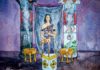
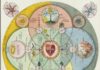
For some time now some of us in the Rose+Croix community long-suspected that Lévi did in fact finish his Tarot. Why this belief? Because Kenneth MacKenzie on his visit to Lévi in France said that he was shown a manuscript fitting that description. After him, it was also seen by a Lévi biographer named Paul Chacornac and over the years several sources have independently published images of his final designs identified as being from an unpublished Lévi source; including in the following editions of the French the Almanach Astrologique and Le Voile d’Isis:
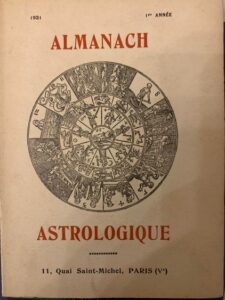

Some of the images published by these publications:
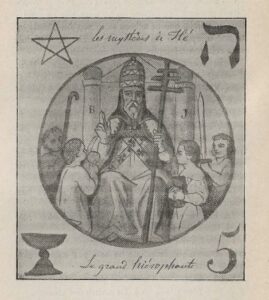

These confirmed to many of us that Lévi had indeed finished his Tarot designs but solid evidence and the manuscript they were in proved elusive. Personally, my belief was rewarded when I saw a facsimile of it during a trip to the Czech Republic some years ago, so I was fortunate in that I knew of its actual existence and was telling anyone who was interested about its existence with many doubting it.
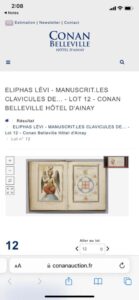
However, the belief of a small number of us was recently confirmed publicly since the long-lost manuscript resurfaced and was sold at auction for 42,000 Euros and as things go today many pictures of it have now been published on Facebook pages.
Because of the sale of the manuscript we discovered that the previous owner had been the suspected Christiane Buisset’s who was the leader of Les Cercles des Amis d’Éliphas Lévi. Here is the online auction advertisement on the right.
What’s in the 1860 manuscript?
Paul Chacornac (emphasis ours) referred to the manuscript as:
….the true original, incomparable, and most complete version (ed. of Les Clavicules de Solomon), which Eliphas Lévi had drawn for himself alone.[1]
The auction house, while citing Chacornac also added that it is (emphasis ours):
An absolutely exceptional manuscript, with various coloured inks by the hand of Éliphas Lévi himself. It is illustrated with 70 figures, plates of original drawings, all of great beauty.
And they also gave out the crucial bit of evidence:
The fifth chapter is dedicated to the explanation of the sacred letters through the tarot.
By the description of these and other parts of the manuscript along with all the photos now available on the internet of the manuscript it is obvious that it is nothing other than the complete 1860 copy of Lévi’s Les Clefs Majeures et Clavicules de Salomon (The Major Keys and Clavicules of Solomon). The problem has been that we have only had the black and white copy of this manuscript which was quickly made by Lévi for his student the Baron Spedalieiri in 1861 and which sadly does not contain the complete designs for his major and minor arcana.
It is important here to indicate that this manuscript, despite the similar name, has nothing to do with Solomonic grimoires. It was never a version of the grimoire called the “Lesser Keys of Solomon” because Lévi was always emphatic that the Tarot are in fact the true Keys of Solomon.
What one finds in it is all the Tarot Major Arcana and Lesser Arcana (pips) illustrated and explained by Lévi. The major cards are drawn out whereas the suits of the smaller cards are organized in geometric shapes invoking their numbers along which are included their corresponding Lévi Talisman for their associated Shemhamephorash Angels.
Historical Impacts
The pips and the Shem:
The newly resurfaced 1860 manuscript has confirmed that Lévi attributed the lesser cards to the angels of the Shemhamphorash and actually designed them for inclusion on the cards. This relationship between the Shem and Tarot is something the astute reader already knew since in his 1865 book, La Science des Esprits (not yet translated into English), Lévi wrote:
The occult book which serves to make these deductions is the Tarot, composed of twenty-two allegorical figures of letters and numbers in four series of 10 and showing analogous symbols to the four letters of the divine name of the “Tetragrammatical Shema”.
Each of these series can be reduced to nine because there are in fact but nine numbers, since the denary is a repetition of the unity.
Four times nine gives thirty-six; the number of the talismans of Solomon, and on each of these talismans there are two mysterious names, which gives the seventy-two names of the Schema hamphorasch.
Mr. de Mirville asks us who we think we are trying to persuade other that the Pagan figures on the Tarot are the Schema hamphorasch of the Rabbis? We do not seek to persuade anyone. We are in a position to prove it to anyone who would like to take the pains of learning it from us.
It is true that the Pagan, Egyptian, etc. figures on the Tarot do not belong to Orthodox Judaism. The Tarot having existed in India, Egypt and even in China at the same time as amongst the Hebrews. That which has come to us is that of the Samaritans. The ideas are Jewish, but the symbols are profane and resemble very much the hieroglyphs of Egypt and the mysticism of India.[2]
Unfortunately, today, many do not know that attributing the Shemhamephorash Angels to the the pip (minor) cards of the Tarot had already begun under the guidance of Éliphas Lévi and with the resurfacing of the manuscript hopefully the esoteric community will be more aware of this and the record can be corrected.
It is interesting to note with regards to this, that despite the fact that Lévi’s Tarot notes wound up in the possession of de Guaita and the OKR+C, these pip cards attributions are not found in Wirth’s Tarot Des Imagiers Du Moyen Âge as the book is only about the major trumps. He also did not include the corresponding Talismans on his cards which closely follow the Marseilles deck.
Fortunately, however, Papus not so secretly revealed a part of Lévi’s Tarot Shem teachings on the image of his pip cards in his second book on the Tarot: Le Tarot Divinatoire. The image included below is an example. These are the original images versus the highly problematic redesigned Papus Tarot cards by US Games. Note the pantacles (seals) on the bottom section of the cards. These are versions of the Shemhamephorash pantacles taken from Lévi’s manuscript: Clefs Majeures et Clavicules de Salomon:

Lévi’s Seals for the Pips on the Papus Cards
What is sad however is that Papus mixed the Lévi seals with others taken from Etteilla and apparently from his own imagination.
The Golden Dawn Shem and the ‘blind’:
These Lévi teachings associating the pips to the Shem Angels did wind up being picked up, though in a very changed way, by the Golden Dawn. The correspondence between the different angels and cards used by the Golden Dawn, like their attributes between the Hebrew letters and the Major Arcana are different than Lévi and if the manuscript is ever fully published we will be able to compare them more fully.
Sadly, many in the Golden Dawn community today use a set of seals (or signatures) reproduced by Ambelain in his La Kabbale Pratique and this despite the fact that Ambelain admitted in the second edition of that book that they are in fact those for the “contrary evil intelligences” and that they are “eminently malefic and excessively dangerous”.
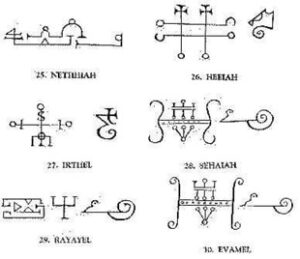
Examples of the Contrary Spirits Signatures (Seals)
published by Ambelain
In order to correct this confusion Shem seals in the French R+C Tradition, in my recent book ‘The Way of the Rose+Croix’ I included the reconstructed Lévi seals by Piers Vaughan as well as those of the Tosgraec Grimoire which Lévi consulted before creating his own and which were used in the R+C before the Ambelain signatures. With these two sets of Shem pantacles, finally, those wanting to theurgical work with the correct Rose+Croix tradition seals can do so and I have given instructions how to do so in the same book.
In addition, related to the Golden Dawn, the whole story made popular after A.E. Waite that the French attributes of the Hebrew letters to the Trump cards were a “blind” by Lévi or the French Masters to hide the “true secrets” completely falls to pieces with this new evidence. Why would Lévi build in a blind in what was a private manuscript for himself and his students. This of course was already disproven in the correspondence to Lévi’s private students which use the same Hebrew letter attributions to the trumps, but I think it begs repeating alongside this new evidence.
Relation to other R+C decks:
The images that we now have from the manuscript show that the major arcana drawn by Lévi are significantly different than the later French Rose+Croix tarot which were supposed to be based on his designs, such as the Oswald Wirth deck. Incidentally this is also the case for those developed in the Golden Dawn (even when compared to Westcott’s earliest designs).
Therefore, it appears that many have been wrong in assuming that the earliest Wirth deck versions are the closest we can get to Lévi’s original designs and if anyone is going to reconstruct the entire Lévi Tarot the manuscript will have to be published first. Having said that, the recent facsimile reproduction on Lévi’s notes on the Marseille deck by Marco Benedetti, has proven what Papus said in his Tarot des Bohémiens about Wirth receiving Lévi’s correspondences through de Guaita. Due to Benedetti’s efforts this can now been proven by comparing Lévi’s notes with the correspondences found for each card in Wirth’s Tarot Des Imagiers Du Moyen Âge (translated as ‘The Tarot of the Magicians’). When that is done it is indeed clear that Lévi is the source.
The Baphomet and The Devil card:
Furthermore, now that we have Lévi’s design for the Tarot Trump “The Devil” and his personal design for the Baphomet from his private manuscript we can see how fundamentally different they are. According to Lévi the Baphomet is a symbol of the Astral Light directed towards Enlightenment and the Devil Card of misdirected energy in the service of animalistic (lower) instincts. It is therefore unfortunate that Lévi’s Baphomet image has been used as The Devil card in some post-Lévi Esoteric Decks since that clearly does not line-up with his intentions.

As the situation stands now:
At this point we have publicly available images for all of Lévi’s Major Arcana except for 0-22: Le Mat (The Fool), 2. La Papesse (The High Priestess), 9. L’ermite (The Hermit), 13. La Mort (Death), 19. Le Soleil (The Sun).
It is particularly sad that we do not yet have his design and explanations for La Papesse (High Priestess) card as Lévi attributes it to the Sophia and having it would greatly advance our understanding of his approach to the Divine Feminine. L’ermite (The Hermit) is likely to also reveal a significant amount about his teachings as it is the card he associates to the High Initiate.
Truly, one cannot exaggerate the important impact making the manuscript available in full would have on our understanding of Lévi’s teachings and the evolution of the Esoteric Tarot. Unfortunately, it is impossible, given the buyers’ privacy, to discover who actually bought it at the considerable sum during the auction. In any case, hopefully their “better Angels will win out” and they will not continue to hide their proverbial “lamp under a bushel” as other owners have unfortunately done in the recent past.
I can only implore them to make their light available to all.
Bibliography:
Primary Sources:
1861 Spedalieiri Incomplete Manuscript of : Eliphas Lévi – Clefs Majeures et Clavicules de Salomon.pdf – Google Drive
Facsimile of Lévi’s Tarot Notes : Benedetti, Marco, Lévi, Éliphas, Tarot : La Clavicule de Salomon: Le Protée des Rose+Croix, 2025. (this is a facsimile copy of notes made by Lévi on the Bernandin Suzanne 1839 version of the Marseille Tarot deck.)
Lévi, Éliphas, La Science des Esprits, 1865.
Secondary Sources:
Ambelain, Robert, La Kabbale Pratique, Éditions Bussière, Paris, 2009.
Buisset, Christiane, Éliphas Lévi: Sa vie, son œuvre, ses pensées, Guy Trénadiel, Paris, 1984.
Chacornac, Paul, Éliphas Lévi (1810-1875), Éditions Traditionelles, Paris, 1926. (includes several of Lévi’s lesser-known letters)
Lenain, Lazare, La Science Cabalistique, trans. as The Science of the Kabbalah, by Piers Vaughan, Rose Circle Books, Bayonne, 2020. (also includes reconstructions of Lévi’s Shemhamephorash Talismans based on the Spedalieiri manuscript of 1861)
Papus, Le Tarot des Bohémiens, 1899.
Papus, Le Tarot Divinatoire, 1909.
Wirth, Le Livre de Thot comprenant les 22 arcanes du Tarot, 1889.
Wirth, Le Tarot : Des Imagiers du Moyen Âge, 1927.
[1] Chacornac, P., Éliphas Lévy, 1926.
[2] Lévi, Éliphas, La Science des Esprits, p.170.