Following the publication of Thomas More’s Utopia, a series of Hermetic or Rosicrucian responses were written in imitation of his famous work. These novels, sometimes considered among the first works of science fiction, accentuated scientific and spiritual themes More left implicit in his Utopia. Such novels represent a tradition of “Rosicrucian utopia” where scientific reorganization was combined with a universal reformation.
Thus Thomas Campanella wrote his City of the Sun, Johann Valentin Andreae his Christianopolis and Francis Bacon his New Atlantis. The latter proved most influential, and had debatably Masonic or Rosicrucian themes in addition to advancing the scientific revolution. These Rosicrucian themes, or lack thereof, led John Heydon to reproduce an unauthorized version of New Atlantis with the Rosicrucianism “added back in.” Simultaneously, John Amos Comenius and Samuel Hartlib continued the tradition by publishing two more of Andreae’s tracts Image of a Christian Society and The Right Hand of Christian Love Offered. These texts, translated by John Hall, also informed Hall’s own lost utopian novel, Leucenia. Robert Boyle, a chemist among the founders of the Royal Society apparently considered it a masterwork, but Hall lent the manuscript to a friend who never returned it. Finally, Samuel Hartlib published his own Marcaria, which was probably written by Gabriel Plattes.

Hermetic City of the Sun by Samuel Robinson
In the past few years, Robert Gordon and I have been working on exploring the theme of utopia in Rosicrucianism in our work towards a reader and travelog bringing these novels back to the wider community. Our SRIA Metropolitan Study Group talk to this effect can be found here. In this piece, I decided to continue the tradition to write a new novel in imitation of the old ones, but set in the future, with a Sino-American twist. This short story may seem strange to modern audiences, but I encourage confused readers to seek out the sources it imitates, such as New Atlantis and City of the Sun, both available for free on Project Gutenberg. While this story is an anachronistic experiment, like all joci severi there is an element of sincerity. It imagines a future where industry no longer threatens Nature, and humanity is truly educated by information technology, to effect a unification of the nations of the world. It is Rosicrucian Utopia for the future, and meant to stand as the next chapter (after a brief lacuna for a few centuries) of the original pansophical novels
A DESCRIPTION OF THE REPUBLIC OF
DONACETYN
being
A CITY
at
THE WEST/EASTERNMOST EXTREMITY
of
THE WORLD
~ne plus ultra~
China, 2778 A.D.
At a small wayfarers house, the company is gathered on a night without electricity. The host of the house asks Hui Shen, a well-known traveler and possessor of the elixir of life, to describe what he witnessed in California.
Host: Please, since you have journeyed so far in the intervening months since you last came to this wayfarers house, tell us a story of something you have seen in your travels, a wonder that can entertain us in these late hours.
Hui Shen: Gladly. I traveled far to the East, across the great ocean, to the deserts of California. There are many things I have seen there, but nothing surpasses the city of Donacetyn, a republic which contains the world within itself.[1]
The city is constructed on the slopes of a mountain east of the great bay, the one which contains the golden gate through which all travelers must pass to reach the Beautiful Country. It sits on a high plateau or ridge between a set of peaks. On either side the ridge falls swiftly into steep valleys, and it is set on the promontory in such a way that it is visible far in the distance from the desert around it.
The design of the city is circular, and its streets are radial. These do not proceed directly from the center to the periphery, and instead intersect cross-streets which form innumerable arcs. Some of these streets follow a regular orbit about the center. Others are stochastic: they twist and wind about themselves, occasionally intersecting with the radial streets oriented toward the Center.
Host: It sounds incredibly disorganized! What plan does the city have, or is it oriented towards a specific scheme? Are there districts?
Hui Shen: There are no districts in Donacetyn, and the city was not constructed according to any plan. Its designers did not seek to impose a plan for living onto the innumerable folkways of the city. Planned, circular cities of the world, such as the original Baghdad, are often oppressive to their inhabitants, and many find them unlivable. In fact, originally there was no city designed, and only the Center was established, and the outward fortifying walls which would become the walls of the city, and the terraces which abutted these walls.
But in the many centuries since the Center was constructed, people from all over the world have come to settle at the festival it represents, and they have taken up residence at various stations, and in this way certain streets have, of their own accord, developed a kind of reputation for certain industries or activities.
Thus there is a zone of gardeners, and a zone of industry and construction, roughly delineated. There are, along those streets which run directly from the center of the city to its walls, covered markets. Some say the goods sold in these markets vary from degree to degree, and that at ninety degrees from the main gates you will find food, at one hundred eighty household goods, at two hundred seventy clothing and textiles, and at three hundred sixty or zero degrees bulk goods, industrial materials and hardware of any variety. Others say that this is a myth, as the markets change enough month to month to lack any consistency, and there are several counter-examples to be found on each of the four streets.
They do say though that within this city the whole world is contained, and that you can find an inhabitant of any nation practicing his native crafts. In this way it is claimed that all handicrafts can be found in Donacetyn, and all cuisines, and even (some say) all tongues are spoken, because as I said, in the centuries since the Center was founded, people have settled as envoys from all four corners of the world.
Host: If there are people of all nations, with the commingling of sect, religion and ideology which follows from this, surely there must be extreme conflict among these people? What laws do they have that maintain social harmony?
Hui Shen: The laws are maintained by the order of Archivists, who inhabit the Center, and maintain its stability. However the laws are derived from universal assent, in keeping with the ancient tradition. This tradition originates from the Council of All Nations, a festival that is held yearly at the city, in which envoys come to the Center from all four corners of the Earth, for a celebration of the unique culture of each, and the contribution every one has to make in the world. At this time, courts of justice and ritual are also established, and disputes between nations are resolved. Some of these envoys chose to settle in the area surrounding the Center in order for them to be permanent ambassadors, and some say this is the origin of the city of Donacetyn and formed its first population.
From this came permanent courts and laws which espouse the balance of unity and diversity. For it is the custom of the inhabitants of this city to hold that each nation (even if it is constituted of only a few members, and has not land to call its own) has its own particular contribution to make to the Center, which comes from the Ancestors, should those who represent that nation so choose to make that contribution. Likewise it is believed that all these many nations are one, and that the Center is not just located at the zero-point of Donacetyn, but is in fact everywhere, across the entire world, spread evenly across its surface — and indeed, it goes even beyond the Moon, spreading out into the innumerable universes which inhabit our sky. For the Center is everywhere, and the circumference is nowhere.
In light of this, the inhabitants of this city do not believe that any nation can be inferior or superior to any other, because each is granted its unique dignity from its secret relation to the Center, which passes everywhere. These envoys and ambassadors who maintain permanent positions have created the order of justiciars, who make the laws of the city, and a member of every nation can be found among this order.
Host: What other societies and laws does this city have?
Hui Shen: In addition to the Council of All Nations, there is also a general society for all citizens, which has two distinct chapters, and one grand general meeting where the two societies are joined as one. The two chapters represent the masculine and the feminine principles, but they are not limited to people of a male or a female body, however each individual can only be a part of one at a time. There is the Lodge, which is the masculine chapter, which admits those who identify as masculine, whether their temperament is that of the warrior or of the magician. The feminine chapter is the Coven, where those who identify as nurturers or witches reside. It is important to the inhabitants of Donacetyn that there are two poles which represent the two principles, however there is also a third society which is androgynous, where all genders mingle freely, and those who transcend the binary preside over the union of these two congregations. It is possible for someone who has been part of the Lodge to shift from identifying as masculine and to move to the Coven and vice versa, but this can only occur on either the spring Equinox or the autumn Equinox, according to tradition, and this transition is a momentous event, which is celebrated with much fanfare and ceremony. The meetings of the joint society, where the Lodge and the Coven are one, occur on the summer solstice and the winter solstice respectively. These ceremonies take place in the Center.
Host: What is this Center, and what form does it take in the city of Donacetyn?
Hui Shen: Although the inhabitants believe that the Center is everywhere, in Donacetyn it is incarnated in a temple, created in the form of a great egg. This egg is made of smooth, polished white stones and inlaid with red gems, which cross over the columns and arches carved as reliefs into its surface. This egg is raised up on a structure of several terraces, such that it rises over the city of Donacetyn, and is visible for several miles around, in some places even from the bay, so that people from far away can point to it as the visible incarnation of the universal principle.
Host: This building must be very great, and required a huge effort to construct.
Hui Shen: Indeed, the building is massive, and no one is quite sure how it was made, for the egg is supported from the ground by vast buttresses, which in turn are supported by and support the terraces, and it is along the four terraces (oriented towards the four streets of the city) that entrance to the Center may be made, through the four gates in the walls of the temple.
Host: What rites are done within the temple, and what is its purpose?
Hui Shen: The temple serves four purposes. The first I have already told you, it is the Council of All Nations, which meets once a year to hold its sacred ceremonies and affirm the union of the nations of the world and peace among men. This is maintained by the envoys and the ambassadors who are also the chief lawmakers of the city, or the order of justiciars. The second is that of the academy, which is maintained by the order of scholars.
The scholars have created a different kind of academy than a typical university, because, while it possesses a scholar learned in every discipline, the structure of the university and its curriculum lacks any disciplinary boundaries. Likewise, while it is a prerequisite of students who attend to be specialized in a discipline, in the organizational structure all students and all researchers study all things in common, and present their work in common at a Council of Scholars which meets slightly more regularly than the Council of All Nations, although both meet upon the same stage.
This stage is located within the vast atrium of the egg, and consists of a series of concentric circles lined with seats descending to the center, in order to signify two things. First, that all seated within a circle are equidistant from each other, and are therefore brothers and sisters; second that those who sit nearer to the Center are to be more humble, and that to be close to the Center means that more is asked of one than shall be given. It is this attitude which informs their scholarship, and they hold the production of knowledge to be a sacred act, available to all people of all nations, and that their Council is a mirror of the greater, legal Council which occurs yearly throughout the world.
The third function of the temple is the archive, and it is maintained by the order of Archivists. This order is less often seen than most, but it is the most essential of them all. They practice the art of preserving memory and restoring what has been sundered. With them are entrusted not just documents but artifacts, spoken testimonies, and memories themselves, created in the form of art. They maintain the collective memory of the order of scholars, who in turn maintain the integrity of the council of justiciars, which makes it possible for the Council of All Nations to occur. They record this knowledge in multiple forms, some as books or scrolls, and others electrically.
That brings us to the third function of the temple: the book of nature. The temple is itself an image of the book of nature which is maintained by the archivists, and the book is contained in the archive. The book is repository of all scientific, spiritual, artistic, philosophical, legal, medical or pragmatic knowledge which exists among the human race. Offerings of knowledge or priceless cultural treasures are occasionally made by envoys to the council of all nations, when members of a group feel that they have a work of art or secret teaching that they wish to share with the world (they are never enticed to do so, and groups are encouraged to keep secret knowledge entrusted just to themselves). These are taken by the scholars and passed to the archivists, who give them to the order in charge of recording them in the book of nature.
The center of the book of nature is an alphabet of images, created in a far off ancient time. This alphabet of images demarcates the shape of the Center: some say the alphabet is the path to the center, and that through the integration of knowledge the integration of all the peoples of the world is facilitated.
The order in charge of maintaining the book of nature is the order of pansophers, a special group having the talents of scholar and archivist and whose job is to facilitate the integration of knowledge and experience in a special practice which ensures the health of the archive. In this way, nothing is every lost in the archive, or at least it is rare, because integration is done in a way to make sure harmony is maintained.
The teachings of pansophy are of the integration of disciplinary knowledge, and of how to reveal the Center which exists between all seemingly separate events in such a way that order and harmony and maintained, and things are not simply connected blindly. Rather there is a purpose and structure to the connections made between any two points of data, and the pansophers maintain special practices to instruct the initiate in when the data is well-structured, and when it is poorly structured.
These four functions of the temple support each other. Thus, the work of the pansophers makes the work of the archivists possible; the work of the archivists allows the scholars to thrive; and the work of the scholar makes possible to unity of manking represented by the Council. In this way, each of the four functions of the temple inform the other, and they serve to make it possible for the Council of All Nations to occur yearly within the World Egg.
Host: Can you describe the Council of All Nations, and what ceremonies occur?
Hui Shen: Certainly. First, there is a ceremonial processions, in which the Mayor (a position which is elected from among the people every three years) marches around the city, to perform the Opening of the Four Doors. These are opened in a sunwise direction, and thus first the East door is opened, and the East wind is called, second the West and its wind, then the South and finally the North. Then, the doors being opened, the envoys who have traveled far throughout the world are formally invited into the city, where they come to dwell in the various travelers lodges which exist there for this purpose. At this time the city transforms into a fair, with many showcasing the latest art or drama their nation has produced, and several restaurants featuring cuisines that can only be found at this time are opened.
These festivities go on for several days, until the order of justicars asks permission from the order of scholars to open the temple, who in turn ask the archivists, who in turn ask the pansophers. This ceremony takes place in the stage of the great egg, where each order inhabits a quadrant of the stage corresponding to one of the four winds. When the pansophers grant their permission, and this is passed to the the three succeeding orders, the four gates of the temple are likewise thrown open, and the envoys are invited to enter for the council itself, which lasts a week. During this period, the justicars take over ceremonial control of the temple and are responsible for administering the proceedings.
First the issues of international law are addressed, and secondly any disputes which need to be brought forth are put forward, and if they are, should any secondary bodies be called on, such as the courts. There follows a long period of ceremony, and finally the council closes in a rite to affirm the unity of humanity, universal harmony, and the essential truth of all religions.
Host: You mention religion, and that the Center of this city is a temple, yet you have made no mention of the religion of its inhabitants, only that they encourage harmony among all religions. Can you tell me more of this?
Hui Shen: Their religion is secular, and officially the city of Donacetyn has no religion. Rather, they teach that the truth of all religion, creed, or artistic form gives way before the Center, and that, seeing as it is everywhere, the transcendent truth that it represents is also reflected in the laws and teachings of all mankind. Where there are religious disputes these are resolved through the Doctrine of Relativity, whereby seemingly logical contradictions are brought into ever greater forms of harmony until all differences are elided. The secrets of this practice are maintained by the pansophers.
Host: Can you tell me more about the teachings of the pansophers, and what the nature of pansophy is?
Hui Shen: The teachings of pansophy are that unity is the Center of creation, and that all things are reflections of those without form. The practice of pansophy is to recreate this underlying unity through correspondence, association and recollection. In this way also are all documents, be they literary, oral, in the form of song, poetry, painting or prose also unified, and all their connections continually created and reconstructed in the great database that is the Book of Nature. Similarly, all disciplines of the liberal arts and sciences, whether of the ancient Quadrivium or Trivium or any of the practical arts, as well as medical or legal, all are harmonized in a web of associations which shows the connections between them, and this is recorded in the book of nature. Similarly, as far as it is possible, teachings between people and languages are translated in the book of nature.
Host: What is the nature of the alphabet of images and the translation between languages?
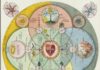
Hui Shen: The alphabet of images is ancient. They say it was given to humanity by a man named Hermes. The images correspond sometimes to things, sometimes to thoughts, sometimes to numbers, and sometimes to the spoken word. These are woven together depending on the context and how they are written. They are written in a special space which takes a geometric form, sometimes a sphere, sometimes a cube and sometimes a cone depending on the information represented and manipulated. These icons represent the plants and animals of the world, the occupations of humanity, natural features and the celestial bodies. They are also found painted throughout the city of Donaectyn at particular points, such that the entire city is a testament to the living book of nature. These icons are the alphabet of the book, and they are the record in which all sciences are maintained and integrated. They are the pansophical keys of Nature. [1]
[1] This short story is based on a number of Renaissance novels which trace themselves to Plato’s Republic and Thomas More’s Utopia. They are Francis Bacons’ The New Atlantis, Thomas Campanella’s City of the Sun, Johann Valentin Andreae’s Christianoplois, John Amos Comenius’ The Labyrinth of the World, and Samuel Hartlib’s Marcaria. These novels had a great influence on the dream of an antilia, or utopian society, which would lead to the foundation of America, with all its bliss and its ills. This story returns to that conversation, by imagining a similar utopian city in the California of the future.
This is not what I would call a story, neither of these people are Characters at all in any way, and this city description is pointless if you don’t talk about how the people are affected by it on an individual level. This is just a long description of an idea. Like, the reason we read SULTANA’S DREAM is because it was incredible work for its time and place, even though not really anything happens in it (and also it was all a dream). The reason we watch ALITA: BATTLE ANGEL is for the individual characters, which are our window into why the city works like it does. Why are we reading this? WHO does it affect? WHO do we care about?