
For the past several years, I have worked on a series of projects entitled Ecologica Pansophica, a kind of “Universal Ecological Wisdom,” deriving its inspiration from the English urban planner and social reformer Ebenezer Howard. This work has taken the ambitious form of creating diagrams of cities that incorporate greenbelts, while also engaging with models of agricultural living.
In 2025, as part of this project, I launched a small duck farm producing organic eggs. Around the same time, through a synchronous series of events, I became acquainted with Frater O.D., who has started a far more auspicious and successful agricultural project than mine. What I took from this encounter was an indication that I was not the sole person being guided in this direction.
The Big Picture: Garden Cities
Disillusioned with the polluted, overcrowded cities of the Industrial Revolution, English urban planner and social reformer Ebenezer Howard (1850–1928) outlined a form of utopia in his book Garden Cities of Tomorrow (1898). Howard laid out an egalitarian vision of urban life that integrated greenbelts and communal ownership. His proposal for garden cities sought to construct cities that embodied a form of divine love, restoring the relationship between man and nature.[1]
Howard lived during an era in which industrialization had blackened the skies, poisoned the rivers, and generated vast slums where disease spread fast among the poor. These conditions were not, in his view, side effects of progress but symptoms of a disconnect. Industrialization had created a divide between man and the natural world so vast that the ‘portal’ to the divine source had been closed.[2] He believed that reestablishing our relationship with nature could reopen the portal, allowing man to once again live in balance with the natural world.
Howard believed his garden cities would create a perfect blend of urban and rural living.[3] He envisioned circular cities where people could gather and thrive in the presence of nature. Garden cities would be built on common land, shared and accessible to all people, and designed so that health could flourish alongside the natural circulation of water and clean air. Each city would be limited in size but large enough to foster a public spirit. Once a city reached an allotted population, new garden cities would be built and connected via roads and canals, forming an interconnected network.

At the center of each of the garden cities would be a glass arcade, encircled with concentric boulevards and greenbelts containing gardens and parks. Due to the concentric schematic, neighborhoods would be beautiful and well-lit without pollution or overcrowding. Residential institutions, such as convalescent homes, would be located within the agricultural belt, allowing residents to appreciate the surrounding scenic environment.
In my version, the glass arcade would be dedicated to Apollo, pulling down the solar current, while the greenbelts – like those of certain sacred gardens – would be dedicated to Venus, transforming these garden cities into magical talismans.
Human virtues must form the foundation of this project. Howard believed that the presence of nature would make people more virtuous. In my version, I would also incorporate the Pansophic method of learning through the senses, expressed through emblematic representations of moral order embedded within the gardens and parks.
Howard envisioned an economic system that allowed people to live in good conditions while ensuring their work was valued and rewarded. He believed that economic policies should go hand-in-hand with a vibrant social and recreational life, in which the cost of living would not undermine leisure, and public assets could be used to support innovation and business growth. Within this framework, people could pursue their own goals while working together for the common good.
 He supported a range of social reforms to promote public welfare. These included temperance reform to reduce alcohol consumption, redistribution of land to increase agriculture, and regulation of railroad pricing to ensure affordable transportation. Vulnerable children would be protected from abuse and exploitation and provided with proper education, while organized efforts would support the education and welfare of women. Pensions would guarantee basic living standards in retirement.
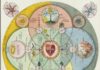
Howard believed the foundation of his cities would rest on the working in tandem of religion and science, although he did not go into detail about how this would be accomplished.[4] He advocated the object-lesson method of education, teaching through observation and hands-on experience, aligning with the ideas of Comenius.[5] Free association, the gathering and collaboration of individuals, would also have a significant role.[6]
Howard opposed the excessive concentration of government power, which he perceived as restricting individual freedoms and impeding the public good.
The cover of Garden Cities of Tomorrow, with its goddess-like figure, is in-line with Pansophic thought in that it unites divine wisdom and human reason, depicting urban planning as sacred.
The Smaller Picture: Houses of Service
Since garden cities are a grandiose concept, let us focus on some of the houses in our cities.
I believe that the Rosicrucian tradition must transcend the magical societies of the past and become a force for positive change in the public sphere. According to the Gospel of Thomas, Christ states, “the kingdom is inside you, and it is outside you.”[7] While most people focus on inner work, outer work is often neglected. Outer work is one side of the equation, without which the Rosicrucian tradition – like a mathematical formula – becomes unbalanced.
Adepts serve as conduits for the divine light, causing transmutation in the world, often in the form of humanitarianism. But when magical orders produce nothing of substance – no meaningful impact, no lasting contribution – can they claim to be effective conduits for the light?
Despite the criticisms thrown against it, the Anthroposophical Society has built numerous communities and schools that accomplish real work. AMORC has two museums in California while the Bibliotheca Philosophica Hermetica in Amsterdam possesses one of the greatest repositories of esoteric books and research materials in the world.
The Shriners, with their hospitals for children, are an embodiment of universal healing, operating on donations and personal assets.
I imagine the Freemasons as an outer order providing structure and public-facing support for the following project while the Societas Rosicruciana in Anglia (SRIA) might guide the spiritual side as an inner order. But to embrace this venture there would have to be an embracing of gender roles allowing women to participate just as Co-Masonry has done.
In fact this spirit of inclusion is not new because Co-Masonry, unlike traditional Freemasonry, has long welcomed women into its ranks, offering equal opportunities for development. It stands as a living example of what the following project could become.
I started to envision Houses of Service located in cities and towns that would provide guidance and resources to those seeking help. Rather than focusing on lodge work these Rosicrucian houses would offer free humanitarian services to the public. Each house would have three levels reflecting the threefold alchemical schematic. Houses in urban locations would maintain small gardens while those in rural areas would use regenerative agriculture to farm the land. Rosicrucians would live in these houses on a permanent or semi-permanent basis.
The ground level, associated with the material alchemical principle, would provide free empowerment programs and counseling sessions to the downtrodden. This would of course require teachers and licensed therapists to volunteer their time. A soup kitchen would offer free meals to the homeless while additional space could be used to run clothing banks and public showers. The work done here would demonstrate that Rosicrucianism can be practical rather than idealistic.
The second level, associated with the mercurial principle, would include a small clinic where volunteer physicians provide basic, non-emergency care to the poor. In addition, a library stocked with esoteric books and a classroom for presentations on spiritual topics would be available.
The third level, associated with alchemical sulphur, would be where the adepts of the house invoke the forces of light that filter down through the rest of the house. It would also serve as the lodge where residents could receive their initiations. Rather than restricting initiation to residents alone, members of the public would also be permitted to receive grades. Optional initiation fees would be reinvested into the house to help keep them functioning.
Let’s Get Down to Funding
These houses should be established in locations with active spiritual communities, such as those of Spiritualists and Quakers, because there would be more tolerance for their presence. Establishing the first of these houses would create a model that could be reproduced in other locations.
Initial funding would come from a combination of personal assets and crowdfunding. Donations from philanthropists aligned with the tradition would be crucial. Residents would be able to publish books and operate appropriate business ventures, selling books and courses to generate additional funds.
To minimize costs, houses should be set up on affordable properties. Building a network of volunteers would reduce both variable and fixed costs, while fostering relationships with local businesses could provide additional support. Houses of Service could use social media to boost engagement, while partnering with public institutions could further enhance their outreach. In addition, public lectures and rituals could serve to introduce Rosicrucianism to a wider audience.
Tracking counseling sessions, event attendance, meals served, and participation in programs would allow the houses to measure their success. One consideration for the future is whether each House of Service should have a leader, such as a chief adept, or be run in a democratic fashion. Residents would wear normal clothing rather than the habit of a monastic order.
While action is needed, I have outlined an ambitious model. Several people have asked in private what small steps can be taken, so I have suggested starting with gardening or farming, depending on the size of the land you own. If you have a small parcel, begin with a herb garden; if you own several acres in a rural area, consider launching an agricultural project. Advocate for your local government to establish greenbelts with communal gardens and art installations. Develop a proposal highlighting the benefits of greenbelts, including beautification and civic engagement. Consult with residents and gardening clubs to gauge support, and approach local nurseries for potential sponsorship.
Since Rosicrucians are meant to be healers, there is no excuse not to learn basic first aid. Numerous courses are available, some free and others for a nominal fee. In addition, consider volunteering at soup kitchens, food pantries, homeless shelters, or hospice care.
The Personal Garden: Harmonizing Nature and Magic
As the vernal equinox commences in spring, you might begin cultivating a garden with a rose bush at its center. Surround the rose with herbs known for their healing properties, and consider adding a statue of Christ to dedicate the space. Harmonize your planting with the phases of the moon, sowing the herbs during the waxing moon to enhance their magical virtues. Instead of using chemicals, enrich the soil with compost and plant-based nutrients to nourish your garden without poisoning it.
Thriving gardens often attract unwanted guests, making pest control essential. Marigolds act as natural insect repellents, while basil and mint can help deter rabbits. Beneficial insects, such as lacewings, that feed on invasive insects can serve as guardians. Cultivating a diverse environment can turn your garden into a semi–self-sustaining ecosystem.
Whenever the moon is in the twenty-fifth mansion, the practitioner should bless the garden with the following prayer:
“O Aziel, guard these herbs, that destruction or ill fortune may not befall them.”
As the moon begins to wane, the herbs, now infused with lunar energies, are gathered in a mindful process, reflecting the idea that the decreasing lunar light enhances the concentration of essential oils and active compounds. Once harvested, the herbs can be preserved to be made into healing salves and tinctures.
Footnotes:
[1] Howard, Ebenezer. Garden Cities of Tomorrow. Swan Sonnenschein & Co., 1902, p. 13.
[2] Howard, 13.
[3] See Ebenezer Howard’s “The Three Magnets” diagram in Garden Cities of Tomorrow, pg. 16-17.
[4] See his “The Master Key” diagram. c.1896. DE/Ho/F3 (1938-1941). Hertfordshire Archives and Local Studies.
[5] Howard, “Master Key” diagram.
[6] Howard, “Master Key” diagram.
[7] See Logion 3 of The Gospel of Thomas.