Originally given as a talk to a small working group working in the Western Esoteric Tradition, inspired by Rosicrucianism. While sometimes framed in a Golden Dawn context, the musings on the qualities of an initiate in Rosicrucian groups has a wider relevance.
Many years ago, after delivering a lecture in a fraternal and magical body to which I belonged, I was approached by a zealous new member enthusiastically proclaiming that I must be a ‘high’ initiate. I laughed and said, “Well if I am, it would probably be a secret”! I then reflected that I had a long way to go, like most of us and that being a faschidiot* is, in isolation, a very limited and questionable virtue.
After this more humorous answer I reflected that an initiate is more than just the ability to be knowledgeable and share knowledge, and a true initiate has dedication, morality, social warmth and is of service to the Organisation or Order. To this day I hold true that an initiate is much more than knowledge regurgitated, and with passing years, I ever more emphasise the moral, social and fraternal qualities needed for functional esoteric Orders. This seems especially pertinent in an often harsh and hostile outer world, where cutting, cold and even unhealthily competitive one-upmanship, and admonishments are par for the course.
But the watchword of esoteric Orders is fraternity, the quality of brotherliness and sisterliness, which can include a healthy sense of comparison, even healthy competition, but also well wishes for those with whom we share this bond and a capacity for cooperation.
I sometimes wonder if the form of an esoteric Order isn’t a dying form. When potential candidates inquire about membership and find out about the commitment, some people, perhaps even MOST people do not pursue an inquiry. What they thought they were committing to, and what an esoteric body is and does, were two different things. There is great merit in knowing your own mind and own sense of ‘fit’. Many say ‘not for me!’. If the committed esoteric Order is not a dying form, then at very least the work of bodies with tangible commitments and a coherent identity is for the few.
And we ourselves, as groups, also ensure that those who enter the temple of the mysteries are the few.
If a candidate makes an application, it is reviewed, and appropriately vetted both administratively and subtly. If the contact is through an existing member, we may inquire about the candidate as experienced by that member.
Then there’s the interview, the exploring of expectations from both sides, and exploring social fit, arrived at through meeting, interview and a process of back and forth. As with any interview process there is an eye to how a person carries themselves, the answers they give to questions, and especially the questions they ask. The questions posed by a candidate tells you a lot about their character and their capacity for initiative. The idea of interview and ‘fit’ however shouldn’t be limited by social background, class, race, religion, sexuality or appearance. What one is looking for is capacity: the capacity to work with others, the ability for and attitude of service, and other intangible, dare I say ‘moral’ qualities.
Morality is often seen as a dirty word in our day and age, seen as an archaic monolith of right and wrong that has no place in the modern world. But we are called upon to have integrity, and personal conviction, even if individualised and idiosyncratic. While common values across a society may no longer be shared, the carrying of personal convictions still holds value. These feed into societal norms, and the norms of the groups we come together in to work together.
Our tradition doesn’t offer prescriptive moral codes, though we encounter many ideas and symbol sets that we reflect on and that feed into our ideas and values. They are a kind of mirror for exploring the question of morality, and thus meaning and motivation, described by Leo Tolstoy with the question “What do men live by?”
The answer to such a question will be different for each person individually, but the question, the spirit of inquiry into what motivates and moves us, is central to the human experience.
Each of the founders of the Hermetic Order of the Golden Dawn passed through such a school of moral reflection, Freemasonry. The Masons claim to make good men and women better and to offer practical moral instruction, conveyed through ritual and allegory. And while I don’t necessarily believe every initiate must be a mason, an education in the humanities, in philosophy and in moral ideas is a strong preparatory school for more active esoteric work.
The culture of inquiry is a good schooling, but an esoteric order in a more cognisant and coherent group. Its culture and identity are formed through the shared experience of initiation, and in the oaths we take upon our personal integrity, towards our fellow brethren, and ever looking towards the highest reference point or Ideal. This commonality of experience and shared values is the basis for establishing a group identity, and perhaps also the more ethereal cultivation of an egregore.
As much as certain qualities are sought during the application process in seed form, these same qualities are sought, cultivated and encouraged during membership at a higher octave.
So what capacities should an initiate have, or seek to cultivate? This is a reflection on this question for me, though it doesn’t seek to be prescriptive, or limiting, only to offer mirrors for self-reflection, exploring personal values, and seeds of inquiry. It is also an invitation to reflect on this question for yourself.
This has been structured using the seven traditional planets and the earth, or Terra as shared archetypes for the psyche.
Terra – There are physical needs of having a real-world temple. The first is turning up and participating: a temple tradition with many officers needs warm bodies, and willingness to reliably turn up and do the work of the temple. This also means having ones regalia clean and presentable, and being financially conscientious in the payment of dues to support the financial realities of a physical temple. Much as Peter is the rock upon which the Church was built, we can speak of ‘solid members’ who meet the needs of the order, and who also have solid personal and working lives that give them rootedness. Solid members are the firm foundation of a solid Temple and Order.
Luna – A temple has a rhythmical quality, with a living sense of when meetings are, and how they integrate into our larger lives, their rhythm becoming second nature and part of our sense of order and routine. This rhythmical, habitual aspect also flows into the daily practices of an initiate. Rhythm and structure, the elements of form carry a person in a way that mere willpower fails to do. Experiencing the occult path as something as natural as the ebbing and flowing of the sea, or the brushing of your teeth, and thus as habitual, is the firm foundation for a well lived life, and a well-functioning initiate. These qualities are supported by healthy daily rhythms in all aspects of life. How easy this is, and even how much this is possible is often an inheritance, though even if we struggle with rhythm and routine, we can aspire to improvement.
Mercurius – In opening I have cautioned against the fetishising of knowledge above and beyond other moral, social and magnanimous qualities, but knowledge, and correct communication have a place in the balanced harmony of all. First there is healthy curiosity, the thirst for knowledge, but, very importantly, not necessarily the thirst to be right. We are called to speak and share, but also to listen, acknowledge and value the contributions of others, building on each other’s insights to form a larger, more complete picture is the ideal. The Great Work is no petty game, and is certainly not a competition. We are called upon to be humble, open, tactful, and committed to the good. This good is the good of all members, the tradition and the work, and not the egoistic ‘good for me’ of personal achievement. As well as knowledge we must acknowledge what we do not know openly and freely. This allows us to focus on areas we do know, even specialisations of knowing, serving others with this knowledge and skilfulness, and honouring the knowledge of others. While there is much that we do not know, we can know so much more together than apart so the best model for knowledge is cooperation.
Venus – While there is always much to do, to study and to achieve we also need space for gratitude, celebration of others, joy, love, and agreeableness. As a Temple, or study group we often break bread together in the spirit of an Agapé feast. An agape feast is a description of a feast for cultivating love in its widest sense, creating space for mutual interest, and the seeds of true fraternity. Another aspect of the work in this realm is the cultivation of beauty. Creating and cultivating beautiful regalia, temple furnishings and ritual performances. Beauty is an active cultivation calling for preparedness, and in the moment sensuality, experiencing and taking joy in the sights, sounds and scents we have cultivated. It is a constant process of creation and celebration. As Genesis says, “…and He saw it was good”.
Sun – In the Great Work there’s always a risk of extremes, of over immersion in one quality to the detriment of others. But through conscious engagement we are constantly seeking the balance out of our individual wakefulness. In this central, balanced point we can experience the fulcrum of the pendulum which alternates between outer activity of various kinds. In this still place we can perceive all the extremes and mediate and balance them. In this space of overview and balancing out we connect with the inner activity of commitment to the work and to the ability to self-govern. These qualities are the inner aspect that are expressed more externally in the Jovial sphere.
Mars – Astrologically both Mars and Saturnus are referred to as malefices, yet even in extremes there are valuable qualities for the Great Work. In excess Mars can be angry, explosive, even violent, with force exceeding what is necessary. But when balanced by a judicious application we can speak to qualities of strength, forbearance, certainty, power and discipline. While people love the capriciousness of Mercurial inquiry, few are willing or able to tame the intellect and apply it to study towards a fixed goal. Discipline is a cultivated quality initiates need to progress. With the Martial virtues we can also speak about protection and setting limits. The Great Work can be intense, and many people burn hard and burn out, but this Work is a marathon and not a sprint. There are times to speed up, to slow down, to stop and rejuvenate and reorient. All of this means managing our energy, strategically prioritising and taking responsibility for our own commitment. When not properly managed this work can also see people burn out, or externalising blame for what they don’t manage. Activity is also well and good, but we must protect our own vitality, set boundaries, and be open to saying ‘slow’ or even ‘no’. The warrior is often shown holding sword and shield. The sword is the symbol of focus and strength, but the shield is its compliment and protects and sets boundaries. We need both.
Jupiter – In the larger civilisation there is a lot of polarisation, and oftentimes harsh judgement. While there is certainly a need for accountability and self-discipline, there is also a need for benevolent relation to others. When we speak of ours as a fraternity we are also reminded that siblings spat. Human dynamics are complex. But most if not all differences can be reconciled through a cultivated attitude of loving kindness, to ourselves (for indeed who else is our harshest judge?), towards others in our Order, and towards the wider world. When we cultivate compassion we shift our assumptions about others. We assume the good of the other person, and their benevolent intentions. Indeed, the act of right perspective is a creative act, the potential of others unfolding through the lens with which we choose to view them. These attitudes are generous, and generosity begets generosity, mush as animosity begets animosity. This beneficent overview is also a prerequisite for true leadership, for leadership is a moral quality, resting on overview, generosity of spirit and right relation to others. All of these qualities are necessarily balanced by the more austere martial qualities.
Saturnus – Like the martial sphere of activity, Saturnus gets a bad rap! Associated with misery, melancholy and death, Saturn is often seen as a spectral bad guy, but like all things, recognising the opportunity for growth makes a friend of one we might otherwise consider a foe. Rather than just cycles of death, Saturn governs cycles of death and life. One thing passes and another begins. We see this in the renewal of the equinoctial password, in the changing of the officers, and in the matriculated structure of systems like the Golden Dawn. In each grade you have a finite amount of work which is learned and tested for, and then you move on. One thing ends and another begins. Thus, we learn to see change as a source of opportunity as well as sometimes sorrow. The passing of time, and the transformation of the self through biography, growth and progression can engender a sense of wonder and openness. In reaching ever towards the future you are asked to ‘empty your cup’ and be open to new things, even if that means leaving old thoughts, patterns and ideas behind. Progressing within a system is not just the passing of time, but a maturation and deepening. New insights are opened that weren’t previously apparent, even with material we felt we had exhausted. The lessons of Saturnus are conveyed, regardless. Change is inevitable. Some suffer under the weight of change, resisting it at all costs, and some cultivate a more Stoic attitude, accepting that change is part of progress, and, if correctly approached can offer an opportunity. Indeed, time is the great teacher, and we can resist change and miss its opportunities, or we can embrace its many lessons.
___
While we can attribute these qualities to the sephiroth, and thus the grades of the Golden Dawn, or more generally of Rosicrucian initiation, I feel it would be incorrect to completely relate these developmental opportunities or qualities to the grades, as some have previously done. The planets live in us, continuously and throughout our personal journeys. And each of the planets have both virtues and vices, gifts and cautionary tales that call for conscientious engagement. The seven traditional planets make up a cosmos, and thus a cosmology, representative of the whole, and its constituent parts. In our journey through the planets we have touched upon many of the more ethereal, ethical and character-based qualities that are questions for every initiate, whether budding or blossoming.
We can summarise some of the central themes as follows.
Physical Needs – money, equipment, warm bodies
Knowledge – knowledge, lived and experienced, and using this in service.
Moral qualities – moral, social, mannerly, considerate, mediating, discerning, restrained, speak for the good, introducing people of good moral character.
Social – cultivate relationship, bridging, welcoming, reconciliatory, open
Service – doing the work, including the so-called “boring” work. Inner attitude of service to brethren, the temple, the Order, and the tradition, extending the concept of fraternity also into the wider world.
Spiritual Humility – Basically doing all the above while keeping ourselves in check, and balanced out and serving the spiritual impulse of our work rather than our more egoistic personal desires.
As initiators, facilitators and leaders we are required to have, and promote these qualities, hopefully as a higher and more refined octave so that we can role model what a healthy, functional and productive esoteric group can be.
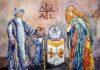
This paper was originally given as a talk, and throughout the talk, as these words were offered, my esteemed fratres and sorores were offered a visual image to reflect upon. This image, which comes from the Splendour Solis depicts the dark man emerging from a black swamp or bog, and a white winged angel on solid ground before him. As an alchemical text this is no mere picture, but a powerful allegory for personal transformation and alchemical change. So I would like to turn towards this image as it relates to the aspiring initiate. 
A blackened man with a red head and right arm, and a white left arm, emerges from a foul stream into a landscape where a winged woman is waiting for him, with a red garment clasped in her hands and held outright, clearly intended for the dark man. The dark man is predominantly black in colour, with his right hand, and head red, both centres of skilfulness, and thus control and a kind of completion or conquering of potential. His left arm is white.
In alchemy there are three to four major stages to the work.
The black work, Nigredo, relates to putrefaction or decomposition. Many alchemists believed that as a first step in the pathway to the philosopher’s stone, all alchemical ingredients had to be cleansed and cooked down to a uniform black matter. In a more spiritual vision of alchemy, the black work relates to looking at and beginning to come to terms with those aspects of ourselves that are chaotic or unconquered. In the Golden Dawn in the outer we meet the image of light dawning in darkness, and the development of the candidate from a state of darkness, towards light. In the Golden Dawn temple we also meet the dynamic interplay of the colours black, white and red as a primary colour scheme.
The White work, Albedo, follows the chaos of the nigredo stage, the alchemist undertakes a purification, literally referred to as ablutio – the washing away of impurities. It is also the whitening, purifying or cultivating a quality that raises beyond the unconquered and subconscious qualities of the black. In the image the man reaches out with his left hand which is white, which is the predominant colour of the angel, along with Gold or yellow. So there is a move from the blackness towards the white, with the aim of bringing light and clarity. The perennialist Titus Burckhardt interprets the albedo as the end of the lesser work, corresponding to a spiritualization of the body, claiming the goal of this portion of the process is to regain the original purity and receptivity of the soul.
An intermediary stage between the white work and the final stage of red work is the yellow work, Citrinitas, the solar dawn or awakening.
The Red Work, Rubedo is the completion of the Great Work, symbolic of Gold and the completion of the Work. In the Rubedo stage the alchemist integrates the outcomes of the work into a coherent sense of self, returning to the individuality but in a refined and progressed form. The symbols used in this red stage can include blood, a phoenix, a rose, a crowned king, or a figure wearing red clothes. The cloak held by the white angel thus represents the transformations of the alchemical work from corruption to redemption or perfection.
In the frame of this plate is the image of a deer, a symbol of resurrection, symbolic of the mans eventual liberation from the swamp and miasma of chaotic life before transformation or initiation.
So why this image? There are many ways to read such images. I chose this image because as I see it, we as initiates are like this man. Parts of us are perfected, parts are more developed than others, but for the most part we remain undeveloped. The angel is representative of higher powers, the way to our goals, guided in our way by the higher principle, whether conceived of as Angel, God or Universe.
We are not finished the Great Work, and we are at various stages of that work, all at once. We are not perfect initiates, but we are on the way to being better tomorrow than we are today.
The making of an initiate is a holistic path of development through service, stretching and developing capacities, and contributing to tradition, all while keeping ourselves in check and keeping perspective.
The ideal initiate isn’t a specific ideal type of person but an individual journey towards becoming more. And like any journey, so long as its still being walked, the path ahead, with time and perseverance, can still be followed with a steady pace and purpose, and perhaps one day lead to journeys end.
Veritas Contra Mundum (V.C.M.), FRC
* German, tr. Fact Idiot, meaning someone that knows stuff and can regurgitate it, but hasn’t necessarily contextualised or integrated that knowledge so that it’s useful.