Thelema, the spiritual tradition and philosophical system founded by Aleister Crowley, is often perceived as radically post-Christian, if not outright antithetical to Christianity. This perception has led many to question how Thelemites, and by extension Crowley’s work, can be considered part of the Rosicrucian tradition, a movement historically rooted in esoteric Christianity.
Indeed, the relationship between Thelema and Rosicrucianism is complex and fraught with tensions that stem from profound differences in theological focus, particularly concerning the role of Christ. However, beneath the surface, significant points of convergence justify viewing Crowley’s work as an extension of the Rosicrucian legacy, albeit in an evolved, Gnostic form.
This article will explore why Thelemites claim their tradition to be the direct heir of Rosicrucianism and the implications of such a claim for the broader understanding of both traditions.
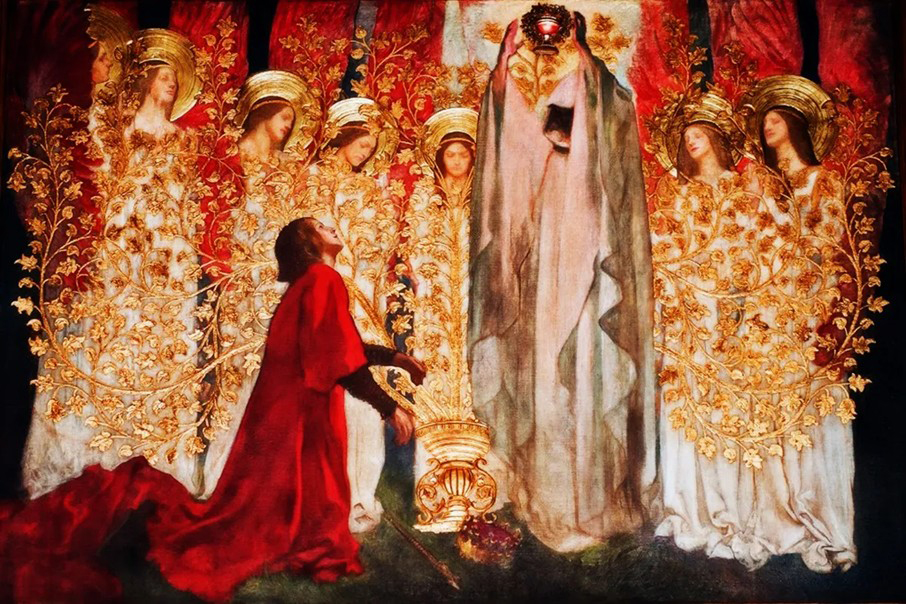
The Holy Grail”, Edwin Austin Abbey, 1895
Rosicrucianism and the Centrality of Christosophia
At its core, Rosicrucianism has always been anchored in Christian esotericism, with Christ playing an essential role in its doctrines and rituals. As demonstrated extensively by Sam Robinson, particularly through his reviews on the various Rosicrucian Orders here on pansophers.com, Christosophia—wisdom embodied in the figure of Christ—remains a defining feature of Rosicrucianism. Robinson reveals that regardless of how different Rosicrucian Orders interpret the figure of Christ—whether as the Son of God, an inner master, a solar Christ, or even a universal resurrection deity whose lineage stretches back to Osiris—the presence of Christ in some form is non-negotiable.
Christosophia, as a guiding principle, represents the transformative wisdom of Christ. This transformation is central to the Rosicrucian tradition, which promises spiritual rebirth through the mysteries of the death and resurrection of Christ. It is a journey that reflects the archetypal path from suffering and death to transcendence and enlightenment. The particular understanding of Christ’s nature may vary significantly from one Rosicrucian group to another. However, it is undeniable that Christ is a core figure within the structure of their teachings as outlined in the Fama. It is this presence of Christosophia that has caused many contemporary Rosicrucians to find the claim that Thelema is an extension of Rosicrucianism deeply problematic.
The Problematic Relationship Between Thelema and Christianity
From a surface-level perspective, the tension between Thelema and traditional Rosicrucianism seems irreconcilable. Crowley, the prophet of Thelema, explicitly declared the advent of a new spiritual era, the Aeon of Horus, which heralded a break from the constraints of the old Aeon of Osiris, typically associated with Christianity. Thelema’s emphasis on the Will, personal sovereignty, and the rejection of traditional Christian morality appear to position it as a post-Christian, and not strictly anti-Christian, philosophy.
Indeed, Crowley’s central Thelemic text, Liber AL vel Legis (The Book of the Law), speaks of the New Aeon in terms that deliberately distance Thelema from the worship of a crucified god. For many, this is a repudiation of the Christ figure who is central to Rosicrucianism. Yet, this reading, while accurate in some respects, overlooks the deeper layers of Thelemic philosophy and its connection to the Gnostic traditions from which it draws inspiration.
The Presence of Christ in Thelema: A Hidden Thread
Contrary to common assumptions, Christ is not entirely absent from Thelemic doctrine and ritual. In fact, Christosophia is subtly present in various Thelemic teachings, particularly in the higher-degree rituals of the Ordo Templi Orientis (O.T.O.), the Order with deep ties to Masonic and Rosicrucian traditions that Crowley inherited. The O.T.O. began as an Academia PanMasonica, a universal order of Masonic and Rosicrucian knowledge. Although Crowley transformed the order into a vehicle for Thelema, the ritual structure retained many elements of its Rosicrucian and Christian influences.
For example, in the V Degree of the O.T.O., there are clear parallels to the Rosicrucian-styled 18th Degree of the Ancient and Accepted Scottish Rite of Freemasonry. These similarities underscore the enduring influence of Rosicrucian and Christian symbolism within Thelemic practices, despite Crowley’s emphasis on new spiritual paradigms.
Echoes of Rosicrucian ceremonial ritual are also found in Liber Cadaveris: Ritual CXX. “Of Passing through the Tuat” , a fundamental step in Crowley’s magico-mystical order, the A∴A∴ In this ritual, the candidate is shut up in a tomb as though deceased for no less than seventy-two hours before being, in a symbolic sense, resurrected. This ritual initiates the aspirant to the Grade of Zelator, the second rung of the A∴A∴ ladder, and the layout of the temple is somewhat reminiscent of the Vault of the Adepts of the Golden Dawn and the Societas Rosicruciana in Anglia (SRIA).

Liber CXX Temple layout, according to a contemporary A∴A∴ lineage working an heavily modified version of Crowley’s ritual, but retaining and integrating the Rosicrucian symbols
It is essential to recognise that Thelema’s Christosophia is highly Gnostic in nature. This Gnosticism, however, is not that of the early Gnostics like the Valentinians or the Cathars. Instead, it reflects the later Gnostic revival of figures like Jules Doinel, from whom Thelema draws a direct lineage. Even so, Thelema’s Gnosticism emphasises spiritual liberation from the demiurgic forces of ignorance and oppression, much like earlier forms of Gnostic Christianity, but without the same focus on the figure of Christ as a saviour from materiality. By the same Christosophic scoring system that Sam Robinson applies to the various Rosicrucian Orders, Thelema would indeed rank low, perhaps scoring no more than a 1 or 2. The emphasis in Thelema is not on the figure of Christ as the Son of God or as the cosmic redeemer, but rather on the Gnostic Christ—a revealer of hidden knowledge, a bringer of enlightenment, and a symbol of personal spiritual resurrection. It is this hidden thread of Christosophia, however faint, that links Thelema to Rosicrucianism.
Alois Mailander and the Call for a Risen Christ
A lesser-known but highly significant figure in this context is Alois Mailander, a 19th-century mystic who deeply influenced both the Rosicrucian tradition and, eventually, Crowley’s ideas. I’ve had the good fortune of seeing early chapters from Sam Robinson’s upcoming work on the Kerning system, which reveals Mailander emphasised the need for spiritual seekers to put down the “Slain Christ” and instead embrace the “Risen Christ.” Mailander warned that we could “only suffer with the crucified Christ and have our bones broken with him.” In taking up the “Risen Christ,” Mailander called for individuals to become warriors in Christ, not passive followers of a suffering and crucified saviour, but active participants in the resurrection and champion Christ form.
This notion of the risen Christ, the victorious Christ who has transcended suffering and death, resonates strongly with Thelema’s concept of the New Aeon of Force and Fire. Crowley’s philosophy promises spiritual evolution through the succession of Aeons, with the current Aeon of Horus representing the “Crowned and Conquering Child” who triumphs over the old order. In many ways, Thelema offers a new form of Christosophia—one that reflects the spirit of the New Aeon rather than the dying Aeon of Osiris.
Thelema as a Continuation of the Rosicrucian Promise
The juxtaposition between Thelema and traditional Rosicrucianism lies in their shared vision of a new age. At its heart, Rosicrucianism has always promised a new era of spiritual enlightenment, a rebirth of humanity through esoteric wisdom and the mysteries of Christ. Nevertheless, many contemporary Rosicrucians remain tied to the Christian frameworks of the past, either Lutheran or Catholic, which the original Rosicrucians sought to transcend. On the other hand, Crowley’s Thelema offers a forward-looking path that embraces the possibility of a new spiritual paradigm—the New Aeon of Horus.
In Crowley’s conception of the Succession of the Aeons, we see a direct continuation of the Rosicrucian promise of a spiritual transformation for humanity. Thelema, in this sense, can be understood as the tantra of this new age, a method of spiritual practice that enables individuals to achieve enlightenment and self-realisation in the New Aeon. It is a path that builds upon the legacy of Rosicrucianism but moves beyond the confines of Christian esotericism into a more universal, Gnostic framework.
Conclusion: Onwards into the New Aeon
The relationship between Thelema and Rosicrucianism is a complex and often contentious one, but it is not as incompatible as it may initially seem. While Thelema diverges significantly from traditional Christian forms of Rosicrucianism, particularly in its emphasis on Gnosticism and the Aeon of Horus, there remains a hidden thread of Christosophia that links the two traditions. The presence of Christ, albeit in a Gnostic form, within Thelemic doctrine and ritual suggests that Crowley’s work can indeed be viewed as an extension of the Rosicrucian tradition, albeit an evolved and transformed one.
For those willing to look beyond surface-level differences, Thelema offers a continuation of the Rosicrucian promise of spiritual enlightenment and the rebirth of humanity. In this sense, Crowley’s work, while post-Christian, is not entirely anti-Christian; rather, it represents a new way forward for the spiritual aspirations that Rosicrucianism has always embodied. The challenge for contemporary Rosicrucians is to recognise this evolution and to engage with it rather than retreat into the frameworks of the past.
On behalf of our readers at Pansophers.com, thank you Marco Visconti for this exciting and thought provoking article!