Over the last few years I’ve quietly worked on a project that delivers a complete set of theurgic rituals for Rosicrucians. This blog post offers the first public view of one of my Pansophic ritual workings.
This project came about for several reasons.
Firstly, one goal in particular was to ensure the next generation of Rosicrucians have a solid basis to do better ritual work.
By ritual work, I mean standard daily rituals and methods that can be applied to multiple tasks. So, I do mean opening and closing rituals that can be used for multiple types of practical operations.
Of course, operative rituals already widly exist, and there are many available. However, do we as Rosicrucians have our own unique set?
I always felt that a lot of the available Rosicrucian operative workings were too wordy and not formulaic enough. It takes time to really build something into solid ritual work, which means several key ideas and cosmological structures need to underpin ritual workings if they are of a quality. What I’ve seen out there in the Rosicrucian world equates to a delivery of large amounts of prayer work and maybe a circle is drawn or some basic holy water etc. is used to bless the sacred space of working. This has proven too underdeveloped to offer students something solid.
That is why many still turn to and depend on Golden Dawn ritual. The dependency on that methodology was the second reason for this project. You will often see non-G.D groups and Martinist Orders, along with Memphis Misraim etc. utilizing the pentagram, hexagram, middle pillar etc. type rituals. A few who try to break away from G.D type ritual often end up simply tracing a cross in the air at the four quarters.
I’m now satisfied with the below given Rosicrucian ritual work. An earlier version of this ritual from five years ago was titled “The Hallelujah of the Heart.” However, that earlier version really lacked the deeper layers which underpin this vastly expanded version. After doing my practice to obtain guidance from the R.C current I wrote down each part of the ritual after witnessing images of a person doing the ritual work.
That resulted in having several rituals and teachings for publishing at a later time but wanted to publish one of them to offer a view of things to come. This particular ritual expresses many traditional ideas.
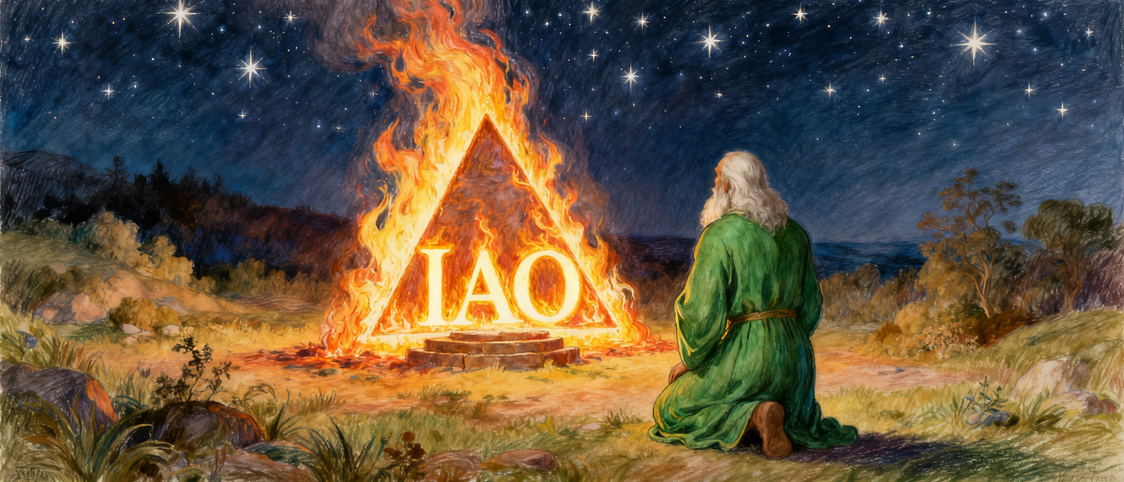
For example, triangles of fire are formulated at each quarter. Each is formulated from the floor level up to chest height. These flaming triangles represent fiery aspiration and symbolize the altars of the ancient fire worship of the philosophers.
Another key idea is that Jacob Boehme’s idea of turning the heart towards God is the main feature of the ritual. The upwards turned heart, pointing towards divinity crowns the formulated triangular altar of flame.
Different states of God are worshiped, through a Panentheistic view, meaning including the view that Nature is Divine with God’s Pressence.
Most notably, there’s no magical purpose for the ritual. We are not seeking to “banish” or “invoke” forces to direct according to our will. Rather, the focus here is pure worship. Rather than a magical intention, we have a theurgic intention. Thus, the altars formulated at the quarters are connected to our heightened state of aspiration. They are objects through which we express devotion, awe and the fullness of worship.
Not being Golden Dawn based, these rituals are purely Rosicrucian. Although the G.D is Rosicrucian in itself, these rituals represent a Pan-Rosicrucian view of the broader tradition.
Now, before viewing the ritual, two important notes:
As mentioned, Jacob Boehme’s teaching that the heart must be changed from its downward pointing nature to instead point upwards is physically enacted in the ritual as the key act. This is done in several steps.
First, there is the formulation of a downward pointing triangle over the heart plexus made with the hands. This is followed by reversing the downward pointing fingers to point upwards. This is done as you step outward, so that you now hold out your hands before you in the shape of the upwards triangle. This effectively crowns the fiery altar of worship you formulated with the divine names.

Jacob Boehme says that a downward pointing heart is in God’s wrath or corrupted fiery world, but when it turns upwards it turns towards the Light in spiritual conversion and rebirth.
Many will know the Secret Symbols of the Rosicrucians prepared by the Golden Rosenkreuzers, and the likes of Frankenburg greatly drew upon Jacob Boehme. This should be well established by now.
The second important point is that there are two different divine names one can employ in this ritual depending on how you approach things. When vibrating the holy name in the formulated triangular altar, you can use either the AION name or YHVH name. The first is Hermetic and the later is obviously the Kabbalistic monotheistic one.
Many will prefer the later YHVH, in keeping with a Christian or Kabbalistic approach. However, the AION version is considered as ideal for Pansophic Rosicrucians seeing that in Hermetic, Platonic, and Stoic thought, the deity Aion was often seen as the “second god,” or rather as the active, intermediate principle acting between the highest, unfathomable Supreme God and the world. Hermetically, Aion is a personification of the same unknowable God who is known through Kabbalistic divine names.
Choose whichever best suits you.
Ritual of the Flaming Triangle
For this public version, you need to start with the Kabbalistic Cross ritual.
- Step forward facing east.
- Kneel down on one knee, prostrating forward touch the earth before you with your left and right hands formulating the base of the triangle with the words:
- Latin: Unum, Bonum, Primum, Monas — Silentium infinitum.
- (The One, the Good, the First, the Monad — infinite Silence.)
- Still kneeling but with your spine erect, bring your palms together in prayer but held above your head formulating the apex of the triangle and say:
- Latin: Aioni sacrum
- (“Sacred to Aion” or “Dedicated to Aion”).
- Now lower your arms, dropping them out at 45-degree angles.
- Palms open, vibrate:
- East (Air): AION ANARCHOS KAI ATHANATOS
(AION, without beginning and immortal)
- The following divine names are to be seen as written or stamped into the shape of the formulated triangular altar of worship. At the intonation of each below name raise your hands higher in four stages.
- AION – Thou Encompassing Everything!
- AIO – Thou Living Formation!
- AI – Thou Holy Imagination!
- A – Invisible, Eternal One!
- At the intonation of the final “A” bring the hands slightly back to thrust salute the hands upwards to Eternity. In this salute, strive to cast your mind to the highest divine ideal. Saying “Invisible, Eternal One!” raise your head upwards.
- Now stand upright while formulating the Sign of Reflection, given from the standing position by creating a downwards pointing triangle shaped over the heart with your hands (palms upon chest, the triangle pointing downwards between thumbs and index fingers).
In this sign say:- Cor meum deo sacrum
(My heart, sacred to God.)
- Cor meum deo sacrum
- Cast your mind to the highest, see the Light, and breath in to draw it down to your heart and the Sign of Reflection held with your hands.
- Then stepping outwards with the right foot, project the arms forward, and, while doing so, reverse the palms outward to face away from you. Now, the still held triangle formulated with fingers from the Sign of Reflection points upwards and crowns the flaming triangular altar of worship of the quarter with the turned flaming heart.
- At the salute, intone:
- AKATALĒPTOS (Incomprehensible) for East (Air)
- Stepping the right foot back again you should now be standing in the Sign of the Lantern. Do this by dropping the left hand to your side while stamping the left foot. At the same time point the index finger of the right hand at the heart. The final thought should be the perception of a flaming Yod inside the heart.
- Give the Sign of Silence while still holding the Sign of the Lantern. Here, the left index finger is held over the lips while stamping the right foot.
Practitioner Notes
The first thing I should say about the ritual is there are two other versions of the Ritual of the Flaming Triangle (also called the Ritual of Turning to Light). There is a lesser and great version of the rite. The lesser offers a quicker version and the greater is more complex.
I should also mention, the Ritual of the Flaming Triangle is followed by its feminine twin, the Ritual of the Holy Spirit, and a third called the Ritual of the Holy Grail. As a set, they greatly expand the Western Mystery Tradition. Although these rites are intended to serve strictly Rosicrucian purposes, its obvious they also expand G.D and Martinist work.
The use of the Kabbalistic Cross is only given for this public preview of this ritual for those who wish to try it. In my final published version, I will give my actual replacement rite which takes the position of the traditional Kabbalistic Cross.
The triangular altar of flame is formulated at each of the four quarters. This means the same 12 steps are repeated at all four quarters. Each quarter has a divine different AION name for steps four and ten. For example, for step ten, the divine names are:
- At the salute, intone:
- AKATALĒPTOS (Incomprehensible) for East (Air)
- PHŌS AIDION (Eternal light) for South (Fire)
- ANARCHOS (Without beginning) for West (Water)
- AGENNETOS (Unbegotten) for North (Earth)
Those using the YHVH version can obviously use the four traditional holy names:
- YHVH for East
- ADONAI for South
- EHEIEH for West
- AGLA for North
For the YHVH version, at Step 3, the term “Deo Sacrum” (Sacred to God) replaces “Aioni Sacrum.” It means “this belongs to God alone” in late Roman, Jewish, Christian contexts.
At Step 5, the YHVH version utilizes the following formula of intonation:
- YHVH
- YHV
- YH
- Y
This Step 5 deserves its own deeper explanation.
Krause and the Holy Names
The teachings of Karl Christian Friedrich Krause factor into my Rosicrucian Rites. A while ago, Ian Gladwin introduced the importance of Karl Krause to the Rosicrucian Tradition comunity. Krause is indeed an important figure in understanding Pansophy as we have it today and is largely overlooked in mainstream occultism. In Krause’s Panentheistic view of describing how God was in everything, Krause distinguished two terms, Orwesen and Urwesen, which are important to us.
In Orwesen, Krause represented the transcendental God. In Urwesen, Krause saw God in Nature. These interrelated terms become God as principle vs. God as whole in oneness.
By conceiving Orwesen and Urwesen, Krause avoided Pantheism because God is not identical with the world. He also avoided classical theism which sees God as separated from the world. For Krause, God is at the same time the absolute higher “above all” while still embracing the “whole in which the world exists.”
I have expanded Krause’s traditional stance through a Pansophic lens. This resulted in the creation of “Ein-Wesen” and “Ent-Wesen” as my own two new terms. Here I specifically extended Krause’s doctrine by applying it to the four Kabbalistic worlds.
- Orwesen is God Above All Transcendental Being.
- Ein-Wesen is God as the Creator Being.
- Ent-Wesen is God as the Formative Being.
- Urwesen is God within all manifest reality.
Krause calls Orwesen “God Above All” and Urwesen “All in God.”
Applied to the Four Kabbalistic worlds we have:
- Or-Wessen – Atzilooth
- Ent-Wesen – Briah
- Ein-Wesen – Yetzirah
- Urwesen – Assiah
Krause’s “God Above All” and “All in God” apply to the highest and lowest Kabbalistic worlds perfectly and teach that this reality in Nature is part of this one being.
My two new terms, Ein-Wesen and Ent-Wesen, extend Krause’s teaching to describe how the process of imagining and forming reality are part of God Himself.
This is quite important because many take the traditional kabbalistic “worlds” to imply they are separate from God. In our Pansophic view, rather than talking about “worlds” we preferably speak about the states of God because all is within God.
Let’s look at my two new terms and their implication.
In German, “Ent” as a prefix added to Wesen indicates “becoming.” This term perfectly aligned with the panentheism of Krause who described the world not as a static creation, but as a “steady becoming” of God’s one life. He taught that the history of the universe was an organic and dynamic unfolding of the Ur-Essence. Thus, while God is infinite as Orwesen, God also contains the finite world within Himself (Urwesen). Thus, the temporal process of becoming must therefore also be part of the Divine existence. Ent-Wesen is our term to describe God’s state of “steady becoming” in the transition to God in Nature.
Linguistically, “Ent” is a German prefix that often indicates a removal, moving away from something, a beginning, or a process of going from one state to another, or the start of an action. It is similar to our “un” in “unfolding.”
In German, “Ein” goes in the opposite direction to “Ent.” When a German word starts with “Ein,” it acts as a prefix meaning “in” or “into” or “inward.” Therefore, “Ein” moves inward while “Ent” motions outward. Through “Ein,” the transcendental God has gathered inwards towards an ideal purpose before formative action commences through Ent-Wesen. Therefore, the Ein and Ent stages represent the “entering” and “unfolding” of Krause’s God state of “steady becoming.”
Kabbalistic teachings traditionally view Briah as a world where the divine emanations from the infinite Ur-Wessen now assume defined structures, that is to say the infinite from above transitions in Briah from pure unity into concepts. As we do not wish to emphasize any “world,” where one might mistakenly begin to imagine separateness from God, we instead view Briah as that state of God assuming all that is to be. All the structures, all the souls, all the beings, all the gods, all the angels, all the ideals, dualities and polarities are God. All the first creative motions, archetypes and images of Briah are still viewed as part of God Himself.
For this reason I have given “Holy Imagination” as an apt translation that captures the real meaning Ein-Wesen which pairs with God’s Ent-Wesen state of “Holy Becoming.”
Finally, we arrive to our Pansophic viewpoint:
- Orwesen – God Beyond All
- Ein-Wesen – God Assuming All
- Ent-Wesen – God Becoming All
- Urwesen – God Residing in All
Ein-Wesen may also be named “God Imagining All” that He is to be. Urwesen could equally be termed “God Embodying All.” All four states are present and constant.
In the Flaming Triangle ritual we worship God in His four states:
- IAON – Urwesen
- IAO – Ent-Wesen
- IA – Ein-Wesen
- I – Orwesen
Those wishing to practice the traditional Judaic Holy Name should use:
- YHVH – Ur-wesen (Eee-Haw-Wah)
- YHV – Ent-Wesen (Eee-Haw)
- YH – Ein-Wesen (Yah)
- Y – Orwesen (Eeeee)
I mentioned at the start that several cosmological ideas and structures need to underpin solid ritual workings. By incorporating Boehme’s turning of the heart into dramatic action and Krause’s Panentheistic views, these new Rosicrucian rituals achieve that on a traditional basis.
I’ll release a more complete version of the Ritual of the Flaming Heart, along with its variations and its accompanying Holy Spirit and Grail rituals in future.