The Pythagorean tetractys decoding the two Circles of Ascension as transmitted by the Oral Tradition of the Rose Croix
The human being consists of three fundamental Principles: the Material, the Psychic, and the Spiritual. This tripartite constitution arises as a reflection of the manifestation of the Divine Being within Creation—Unity expressed in Trinity—wherein the imago Dei is actualized through the threefold unfolding of the human entity.
Note. The conception of the human being as constituted by three fundamental principles—material, psychic, and spiritual—finds its primary articulation in late antique philosophy rather than in early alchemical doctrine. In the system of Plotinus, reality unfolds from the One (to hen) through Intellect (nous) to Soul (psyche), establishing a metaphysical triad that later informed Christian theological anthropology (Plotinus, Enneads, V.1.6).
Early modern alchemy—especially in the writings of Paracelsus—formulates a triplicity of principles known as the tria prima: Salt, Sulfur, and Mercury. These are ontological and operative principles of matter:
- Salt (sal) as fixity and corporeality
- Sulfur (sulphur) as activity and combustibility
- Mercury (mercurius) as volatility and mediation
(Paracelsus, Liber de Natura Rerum, c. 1537)
These three Principles are further complemented by two nodal points within the human constitution: the Material-Psychic (or subtle-material) and the Psychic-Spiritual (or spiritual-material). These nodes function as points of conjunction between the Principles, wherein the interpenetration and synthesis of the constituent elements of the human being reach their highest intensity.
Theosophical and esoteric traditions have often attributed particular significance to these two nodes, regarding them as essential connectors within the totality of human existence. In alchemical symbolism, they were encoded as the Sun and the Moon, whose synthesis yields the Magnum Opus, that is, the spiritual completion of the human being.
Note. The symbolic union of opposites—often depicted as Sol and Luna—culminates in the coniunctio oppositorum, or alchemical marriage. The numerical symbolism associated with alchemical transformation—particularly the movement from multiplicity toward unity—is analogically related to the Tetractys described by Pythagoras and later Pythagoreans (Iamblichus, De Vita Pythagorica). However, while the tetractys traditionally expresses emanation (1–2–3–4), its inversion as a return to unity (4–3–2–1) constitutes a later philosophical reinterpretation aligned with Neoplatonic return (epistrophe).
The analogical structure of this Work thus may be expressed numerically as 4–3–2–1. The tetrad of the elements encompasses the triad of Principles, which, through the mediation of the dyadic nodes, tend toward the Monad. The Pythagorean tetractys is thus invoked as a symbolic key to the resolution of alchemical problems through the following sequence:
- 3 → 4: Dissolution into the four fundamental elements of the prima materia; Nigredo—the death of the ego, blackening, darkness.
- 4 → 3: Purification into a regenerated triadic form; Albedo—rebirth, whitening, illumination.
- 3 → 2: Reunification into generative dyads; Citrinitas—union through fire, yellowing, awakening.
- 2 → 1: The alchemical marriage, or conjunction of the dyads into a perfected unity; fiery union, the Magnum Opus, Rubedo—reddening, completion.
 Two overarching phases may be discerned within this process: a dissolutive phase and a unitive triadic phase. These were represented in ancient mystery traditions by the katabasis (descent, dissolution) and the subsequent threefold trials leading to illumination—symbolizing the reintegration and purification of the constituent elements.
Note. The broader pattern of descent and ascent (katabasis and anabasis) is well attested in Greek religious and philosophical traditions, as well as in Neoplatonism, where the soul’s return to the One involves both purification and transcendence (Plotinus, Enneads, I.6; VI.9).
In later initiatory traditions, these trials were reformulated as forms of Mastery (kyriarchia): mastery over the material or unconscious, mastery over the psychic or subconscious, and finally mastery over the spiritual or conscious dimension of the Principles governing the human being. Completion (teleiosis) is attained through union or return to the Superconscious, variously termed Apokatastasis (in Neoplatonism), Monadization (in Pythagorean terminology), or Perfection in initiatory language.
The final act of Completion, however, proceeds through a movement inverse to that of perfection. What the ancient initiates implied—if not deliberately concealed—is that the processes of perfection achieved through mastery are followed by a contrary act of surrender: the relinquishment of the perfected vehicle of personality (the ego) into the Super-Ego. This act confirms the return to the Superconscious.
This constitutes a passive sequence, in contrast to the preceding active process.
From the foregoing, it becomes evident that Perfection (teleiopoiēsis) and Completion (teleiosis) are complementary yet opposing movements. When one includes the initial dissolutive process as preparatory work, a triadic pattern of alternating stages emerges:
- Dissolution (Passive) — associated with Matter.
- Reunification (Active) — associated with the psychic domain, comprising:
- the etheric (unconscious elemental forces, governed through Power),
- the astral (subconscious forces, governed through Will),
- the mental (conscious, objectified forces, governed through Imagination).
- These transformative principles were encoded as the tria prima: Salt, Mercury, and Sulfur. Through their combinations at each stage, the process moves from the tetradic dissolution of the elements (Fire, Air, Water, and primordial Matter) toward their mastery and transformation into the tria prima, whose synthesis yields the symbolic Sun and Moon. The alchemical marriage of these dyads results in the completion of the ego, symbolized as the Philosopher’s Stone.
- Completion (Passive) — the surrender of the perfected ego into the Super-Ego, or its spiritualization within the Superconscious.
These three processes are themselves symbolically attributed to the tria prima: the passive to Salt, the active to Sulfur, and the passive of surrender to Philosophical Mercury.
Note. The distinction between active transformation and passive surrender finds stronger resonance in mystical theology than in technical alchemy. In Christian apophatic traditions (e.g., Pseudo-Dionysius, Mystical Theology), the culmination of the spiritual path is not mastery but relinquishment—an unknowing union with the Divine.
The differentiation between opus minus and opus magnum appears in alchemical literature, though not as a fully systematized dual-cycle doctrine. Their reinterpretation as “lesser” (psychological or personal perfection) and “greater” (ontological reintegration) works is more characteristic of later Rosicrucian and esoteric traditions, particularly from the 17th century onward.

In conclusion, one may distinguish between the Greater and the Lesser alchemical Work. The Greater Work pertains to the process of Completion, whereas the Lesser Work concerns the process of Perfection—an important distinction that earlier alchemists did not explicitly articulate, whether by omission or by design.
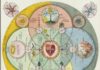
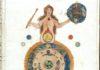
This duality is represented through the Lesser and Greater cycles. The Lesser cycle is tetradic—dissolution, purification, recomposition, and perfection—culminating in the mental plane and the completion of the personality (symbolized by philosophical gold). The Greater cycle is triadic—passive, active, passive—and encompasses the reintegration with the spiritual realm, restoring the being to its primordial nature.
Within Rosicrucian traditions, these processes were encoded respectively as Resurrection (the Lesser cycle) and Ascension (the Greater cycle, or immortality). Both share a common point of departure: the Crucificial Sacrifice, that is, the dissolution of the ego into the four primordial elements, or death.