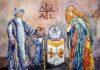
Ever heard of Pensatia? Few have. Her real name was Helen Merrick Bond and she was once a celebrated adept within the AMORC community.
In this post, I had the pleasure to interview Marilynn Hughes who has just written a reveal all book on Pensatia and her Rosicrucian teachings.

Margaret Sarah: Lady in a Green Dress, Seated in an Alcove
Marilynn’s book is titled “Pensatia: Present Balance,” and explores Helen Merrick Bond’s remarkable body of mystical literature left to the Rosicrucian tradition.
Pensatia has largely disappeared from contemporary spiritual history. Pensatia: Present Balance seeks to recover her voice.
At the heart of Pensatia’s vision are powerful symbols: the Flame of White, the Rose of Life, the Inner Signature, the Sacred Center, the High Mountain, the Lotus of Wisdom, the Magnetic Light, the Stone and the Elixir, the Door of the Heart, and the mysterious figure of Master H.
We put sevearl questions to Marylnn Hughs to find out more:
Who was she and how did she develop contact with the Master H?
Early Life & Theological Roots
Helen Merrick Bond was born into an American family defined by strict discipline, deep theological conviction, and grand vision. As the daughter of a Congregational minister, her childhood was completely immersed in a religious environment that heavily prioritized moral rectitude, constant scripture study, and the power of the written word. Rather than making her a conventional churchwoman, this upbringing gave her a rare, robust theological literacy and a profound respect for a spiritual vocation that would later guide her outside mainstream Protestantism.
The Coral Gables Connection
The Merrick family possessed a distinct trait: an extraordinary capacity for grand visualization and systematically manifesting an idealized interior vision into the physical world. Helen’s brother was George E. Merrick, the famous urban planner and real estate developer who founded Coral Gables, Florida. While George directed his visionary drive outward—building an architectural paradise of plazas, stone, and Mediterranean revival canals—Helen took that exact same structured family drive and directed it entirely inward. She spent her life mapping and building an intricate interior architecture of consciousness.
Sixty Years in AMORC
Helen’s adult life coincided with the dramatic twentieth-century global expansion of the Ancient and Mystical Order Rosae Crucis (AMORC). She entered the order during its foundational decades under its first Imperator, Harvey Spencer Lewis, and spent nearly sixty years under structured Rosicrucian discipline.
Far from being an isolated, self-styled New Age channeler, her decades of progress through the order’s traditional monographs provided her with a highly advanced symbolic vocabulary and institutional protection. Her alignment with the hierarchy was so respected that AMORC’s second Imperator, Ralph M. Lewis, knew her personally and held her work in high regard. Although AMORC strictly guarded its private internal teachings, the leadership explicitly permitted and supported Helen’s public distribution of her booklets, identifying her as a pure transmitter of Rosicrucian principles.
The Initiatory Pen Name
When she began recording her inner dictations, she chose to obscure her historical identity entirely behind the pseudonym Pensatia (derived from the Latin pensare, meaning to weigh, reflect, or ponder). Surviving records indicate this symbolic name was not self-chosen, but was bestowed upon her by an interior source to serve as a functional protective shield against personal vanity. By erasing her famous family name from her titles, she forced her readers to step outside the mundane personality and encounter her text as pure, unmediated esoteric wisdom.
Final Years & Legacy
Helen lived a quiet, deeply respected life within her immediate spiritual community, completely consumed by the Western esoteric tradition. When she died in 1988 at the age of ninety-four, the Rosicrucian Digest published a formal remembrance honoring her legacy, stating that her twelve published works had contributed deeply to society and that she was a woman whose life was profoundly changed by her long encounter with the Order.
Who was her Master H? A theosophical master, an adept?
Master H is characterized as a Rosicrucian Adept of the Western esoteric tradition.
Rather than a traditional, disembodied Theosophical Master (like El Morya or Koot Hoomi), Master H is characterized as a Rosicrucian Adept of the Western Esoteric Tradition. He serves as a localized, distinct initiator whose edicts focus heavily on practical spiritual development, character alchemy, and the severe but beautiful demands of the path.
Master H shared extensively with Pensatia his past lifetimes and the process that led him to becoming a Master in her first book entitled ‘Master H’ and their relationship extended throughout her entire life, as he extended his Master/Disciple relationship and teaching towards her for sixty years.
“The external teacher functions as a necessary mirror. Because the unawakened human being cannot look directly at the fullness of divine nature without first undergoing purification and preparation, the inner spark is encountered outwardly in the form of a Master. As the purification deepens, the relationship becomes increasingly interior. The voice of Master H becomes inseparable from the disciple’s developing consciousness of the Master Within.”
Pensatia: Present Balance, By Marilynn Hughes
What is the core message of her teaching?
Her core teachings emphasize achieving inner balance and transforming everyday life through spiritual realization rather than escapism. Her path involves a disciplined daily practice of inner stillness and perseverance, guiding seekers through spiritual evolution toward divine integration.
Please could you elaborate on her 12 stages of initiation.
The 12-part system absolutely exists in the book—The High Mountain – it is structured exactly as Pensatia experienced it, as 12 sequential, unlabelled chapters mapping a fluid spiritual progression. In the authentic Rosicrucian tradition, these strata of consciousness are not given cheap, modern self-help labels; they are experienced as raw, unfolding milestones. Your readers and contributors will actually find this unvarnished, true-to-history architecture much more compelling than a artificial chart.
I love that your pansophers blog focuses so deeply on the Rosicrucian tradition. To address the 12 stages, I want to clarify how the book approaches this so we can give your readers an authentic experience.
In her actual writings, Pensatia intentionally avoids rigid labels, charts, or a clinical step-by-step checklist. To remain completely faithful to her style, my book structures her journey across 12 fluid, unlabelled chapters that mirror her progressive strata of consciousness.
However, to give your 28 contributors and readers a concrete framework for discussion, we can create an imagined landscape that follows her loose progression. This interpretive map captures the deeper alchemical transformation analyzed throughout the book:
- 1. The Awakening (The Discovery): Realizing the Divine Spark hidden within the ordinary self.
- 2. The Call to the Mountain: Moving from casual interest to a binding commitment to discipleship.
- 3. The Stripping Away: Voluntarily detaching from lower egoic identities and material illusions.
- 4. The Threshold of Shadows: Confronting the personal unregenerated self (the dweller on the threshold).
- 5. The Valley of Humility: Cultivating absolute passivity of the personal will to allow the divine will to work.
- 6. The Stage of Transmutation: Actively purifying thoughts, speech, and desires through spiritual alchemy.
- 7. The Ascent of Patience: Learning to endure spiritual dryness and tests without demanding immediate rewards.
- 8. The Illumination of the Heart: An inner flash of divine reality where love replaces duty.
- 9. The Crucifixion of the Self: The ultimate surrender of the independent ego-self.
- 10. The Resurrected Consciousness: Emerging into a stabilized, unshakeable state of divine connection.
- 11. The Descent for Service: Returning from abstract heights to bring light back down to humanity.
- 12. Divine Integration (Present Balance): The final, perfect synthesis of human life completely infused with Divine Presence in the present moment.
This gives you a structure, while honoring the fact that the book itself lets the raw, unlabelled mystery unfold naturally.
Furthermore, to tie this narrative journey directly into core AMORC philosophy, the book’s practical chapters tightly align with the traditional 12 Rosicrucian Esoteric Virtues that every advanced student seeks to embody:
- Patience: Enduring trials and waiting for organic spiritual maturation.
- Trust: Placing total faith in the cosmic higher order and laws.
- Temperance: Avoiding destructive extremes and practicing moderation.
- Tolerance: Respecting the diverse expressions of consciousness and life.
- Detachment: Releasing egoic desires and material attachments.
- Altruism: Unselfishly prioritizing the elevation of humanity.
- Integrity: Aligning outer actions with inner spiritual illumination.
- Humility: Recognizing the natural limitations of the finite personality.
- Courage: Wholeheartedly facing the dangerous thresholds of the path.
- Non-Violence: Radiating harmony and protecting the sacred network of life.
- Benevolence: Cultivating active kindness and a desire to heal suffering.
- Wisdom: The perfect synthesis of all spiritual illumination into real-world action
By layering these 12 foundational principles alongside the 12-chapter narrative structure, you have a comprehensive, structurally sound framework.
What was her practical teaching? A daily practice?
Pensatia’s path is highly demanding because it rejects glamorous, superficial occultism in favor of disciplined daily practice. Her practical instructions center on:
The Practice of Inner Stillness: Dedicated daily times of quietude to tune out worldly chatter and listen for the inner voice.
Present-Moment Awareness: Seeing every daily irritation, trial, or duty as the specific raw material for spiritual transmutation.
Quiet Perseverance: Consistently practicing devotion even when the initial emotional fervor fades away.
Practice and Daily Life: Pensatia believed true spiritual practice evolved into daily life, and spiritual practice that did not do so was not true.
Please could you share two quotes from the book.
“…The Path is revealed as a reality . . . To be aware of this mystic way, or road, is to function fourth dimensionally, to come close to the divine signature of all life. Every commonplace experience or mundane duty takes on a new note… To one who walks the Path, the most common toil appears like a princely assignment.” –A Journey into the Light, Volume II
“Swiftly as the flight of an eagle I enter the heart and thus on to the clear, cool environs of the Cosmic garden. I see the Master and drink once more his words of wisdom . . . ‘This petal of the Lotus is that which all students faithful and obedient desire above all else, that petal of the heart’s centre which entitles one to the presence of one’s Master. And truly this is the fragrance, the star of the heart’s Lotus, the magic of all the Path.” Pensatia, A Door of the Heart
“Spiritual literature frequently treats illumination as an escape route from the physical world, urging the soul to flee the material plane for higher, unverified realms. Pensatia’s vision demands the exact opposite. It introduces a dynamic equilibrium where transcendence and embodiment must intimately communicate” Pensatia: Present Balance
“A mystic who organizes their life’s output into twelve distinct vessels (her books) is not writing random essays as inspiration strikes. They are consciously constructing a complete temple of thought. Each book acts as a specific pillar designed to hold up a segment of a unified dome of consciousness.” Pensatia: Present Balance
“While she respected the fraternal structure, her writings focus entirely on the interior mechanisms of the path. She did not write about lodge administration, degrees, or organizational politics. Instead, she treated Rosicrucianism as a living, dynamic branch of the Hermetic tree of wisdom.” Pensatia: Present Balance
There you have it folks!
On behalf of Pansophers and all our readers, we warmly thank Marilynn Hughs for this enjoyable and eye opening interview!
To find out more, please visit Marilynn’s website where you can order the book: https://www.outofbodytravel.org/pensatia-present-balance
For those interested, Marylin Hughs has written extensive on several esoteric subjects. See her extensive sixteen book series here.

Biography:
Marilynn Hughes founded The Out-of-Body Travel Foundation in 2003 (Mission: Reduce Spiritual Hunger Worldwide). Marilynn has experienced, researched, written, and taught about Out of Body Travel and Mysticism since 1987 and has spoken on dozens of radio and television programs to discuss her thousands of out of body experiences. Marilynn Hughes has authored 148 books, 40 magazines and 18 CD’s on Out of Body Travel and Comparative Religious Mysticism including her seminal classic The Mysteries of the Redemption: A Treatise on Out-of-Body Travel and Mysticism of which she has Written, Directed and Produced the adaptation – All the Winds of Heaven – AI Film/TV Series. She was featured in the documentary film, The Road to Armageddon: A Spiritual Documentary, and in Documentary Film Productions: The Grand Phases of the Soul, The Stairway from Earth to Heaven, How to Have an Out-of-Body Experience, The Tao of Mysticism, The Initiations into the Mysteries, The Rites of Passage, The Prayer of the Twelfth Hour and At the Feet of the Masters.