Looking into Forgotten Rosicrucian Masonry
Thanks to all your support and keen interest, this blog and our Facebook group have become the central platform to discuss the work of J.B Kerning, his internal alchemy, and the Rosicrucian version advanced by Alois Mailander. In the course of writing my latest book, I investigated members of Kerning’s lodge and their writings.
We have already shown that one Dr. Johann Leutbecher (1801-1878) joined Kerning’s lodge in Stuttgart, and went on to establish the lodge Licht Liebe Leben (Light, Love, Life) in 1864. This is significant because Mathers and Westcott, founders of the Hermetic Order of the Golden Dawn, claimed their fraternity arose out of one lodge Licht Liebe Leben in Germany. Their famous contact Fraulein Sprengel (named as Anna Sprengel by Felkin) was stated to be a member.[1]
Another member of Kerning’s lodge was the Potsdam born physician Ferdinand Katsch (1828-1896), who is an unsung hero of the Rosicrucian Tradition.
He wrote Die Entstehung und der wahre Endzweck der Freimaurerei (The Origin and True End Purpose of Freemasonry), which was published posthumously in 1897. In this work he sought to prove Freemasonry emerged from the Rosicrucian movement. His scholastic overview explored materials from 1604 to 1723. He concluded it was the alchemist Michal Maier who brought Rosicrucianism to England via Robert Fludd, who then changed its name to “Freemasonry” due to the disrepute into which the Fraternity of the Rose Cross had fallen.[2]
Katsch references Kerning several times in his book, likely due to the fact many saw Kerning as introducing Rosicrucian spirituality into masonry.[3]
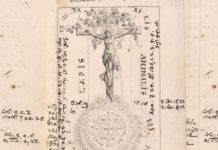
Some time ago I came across this image from a German book collector showing an article by Ferdinand Katsch. It’s fascinated me, so I bought the booklet, despite it costing 350 Euros. I had once read that Ferdinand Katsch wrote lessons for his own circle to perpetuate Rosicrucian Freemasonry and this 50 page article inside the booklet proved to be a brilliant investment. It shows Katsch was extremely well read and actually developed an advanced “Rosicrucian Kabbalah” from Fludd’s writings.
(Click to enlarge image)
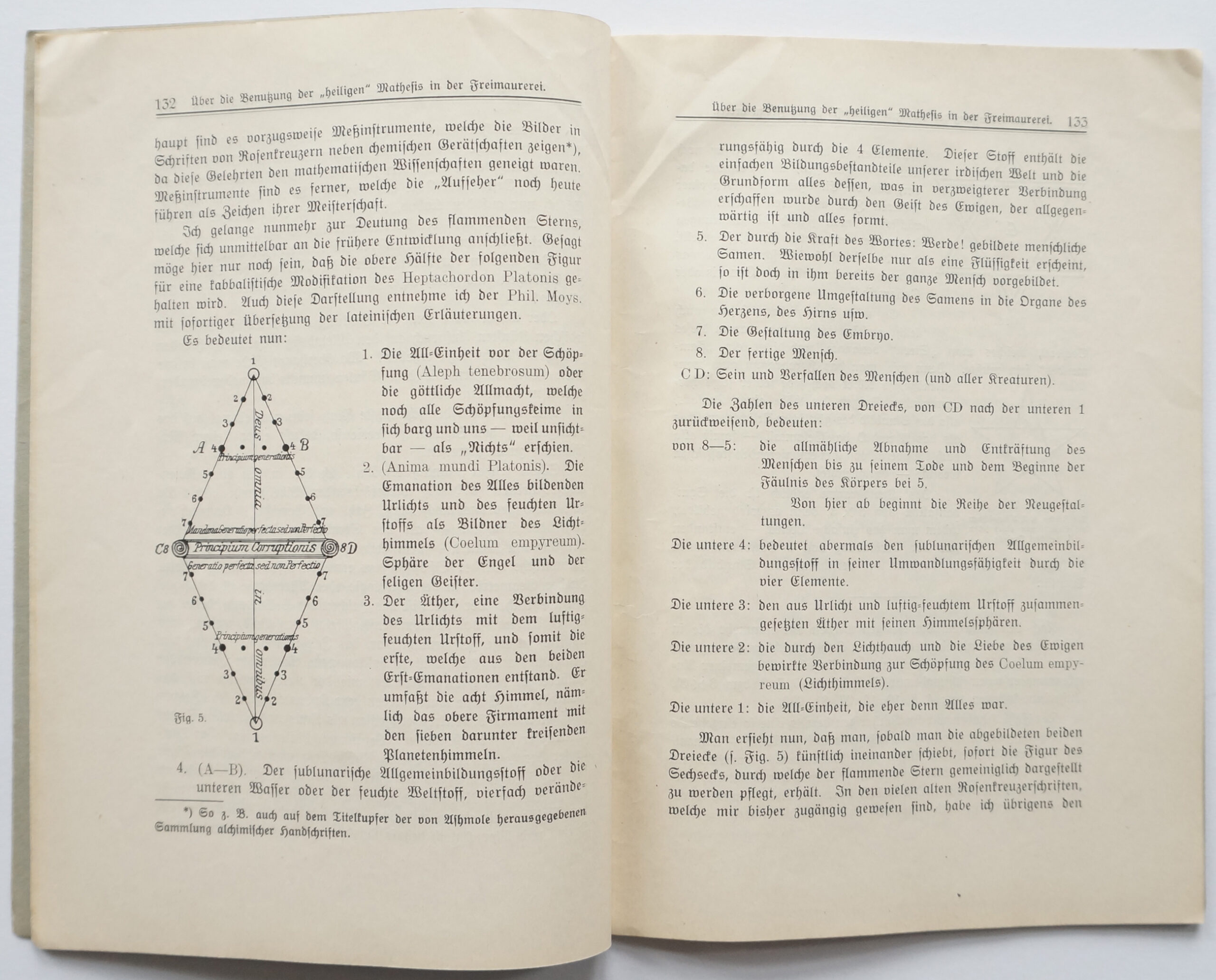
Katsch’s article is on “the use of “sacred” mathesis in Freemasonry,” and he interpreted Genesis as representing a connection between the “Primal Light, the air and Moist Primal Matter,” so that the first waters of creation formed a apparently feminine “sublunar universal moist fabric of the world.” God’s announcement “Let there be,” was both the Word and the seed, which served to impregnate the first waters. Out of this, nature runs its course to evolve the first embryo and first human in Adam.
The term “Aleph Tenebrosum” stands out on the left hand page. It is associated to position “1” on the upper triangle, along with seven other numbers descending. The downwards triangle has another seven numbered position and its interpretation is given. The text describes bringing these two triangles together to obtain the flaming star. Such diagrams of two triangles are often important to Kerning practitioners. I must stress how this “Aleph Tenebrosum” is an important term in Fludd’s Kabbalistic ideas. It is the “Dark Aleph,” which withholds Light unto itself, in contrast to the “Aleph Lucidum,” or the Light Aleph, which shines forth. Thus, a new “Rosicrucian Qabala” was created by Katsch.
My friend Christine Eike kindly translated the second page.
A cabalistic modification of the Heptachordon of Platon.
1 The All-Oneness before creation (Aleph Tenebrosum)…
2 The Emanation of the primal light that creates all…
3 The Ether. A connection between the primal light and the airy and moist primal matter…
4 The sublunar general fabric or the moist fabric of the world…
5 The human seed that it generated by the power of the word ‘Let there be’. Though the same appears only as a liquid, yet the whole human being is executed by it. [der durch die Kraft des Wortes: Werde! gebildete menschliche Samen. Wiewohl derselbe nur als eine Flüssigkeit erscheint, so ist doch in ihm bereits der ganze Mensch vorgebildet].
6 The hidden transformation of the seed into the organs of the heart, of the brain etc.
7 The formation of the embryo.
8 The finished human.
The booklet title is “Johannismeisterhefte der Zirkelkorrespondenz.” Some of them are still available to order, but it appears I own the last copy of this particular edition. I have been meaning to translate it or pass it onto Martin Faulks for publication in some masonic publication.
One of the surprises is that it shows Katsch had a clear knowledge of Qigong or Taoist internal alchemy, which I did not expect. Given that Katsch died in 1897, it is remarkable because even the German Theosophists were still adapting eastern yogic type breathing exercises. This seems to paint a picture of what kind of internal arts were explored in Germany prior to the founding of the pre-Crowley O.T.O. Tibetan Tumo also caught the interest of a few in the 1890’s.
There is obviously a sexual element to Katch’s diagram and its explanation. The word he uses for “seed” is “Samen” in German, a term equally meaning “sperm” which impregnates the sublunar fabric of the cosmos with “Let there be.” I may be reading into things, as his presentation of the sexual element is conservative, yet Ferdinand Katsch appears to be the only initiate directly coming out of Kerning’s lodge who went on to describe a connection between of “sex and the Word.” This certainly becomes stronger when viewing the original pre-Crowley O.T.O and Rudolf Steiner’s Grail teachings from 1905 onwards. I explore this subject in relation to the sexualized Kerning 4.0 version in my book.
Special thanks to Christine for her translation and to all our regular readers who positively support this blog.
[1] Leutbecher wrote a paper for Mozes Salomon Polak’s Die Tapis in ihrer historisch-paedogogischen, wissenschaftlichen und moralischen Bedeutung.’ (The Tapis and their Historical Educational Significance for Morals and Science’). See Ian Gladwin’s Revealing Westcott’s Lodge of Secret Chiefs: Licht, Liebe, Leben – a Golden Dawn Origins Revelation on Pasophers.com
[2] Katch. Die Entstehung Und Der Wahre Endzweck Der Freimaurerei (1897). In this book he quotes Kerning several times while building up his argument by examining the earliest Rosicrucian writings.
[3] Johannismeisterhefte der Zirkelkorrespondenz by Adolf Widmann, published 1929-1937, contained Katsch lectures. Katsch also mentions the Tao, Qigong, alchemy etc.