
Introduction to the Martinist Order Review
You are now reading a Rosicrucian review of the Martinist Order.
(Updated with new content for 2020, from original review of 2015).
My name is Samuel Robinson and this is part three of my Reviews of the Rosicrucian Orders.
 In this review you’ll find out about the Rosicrucian elements of the Martinist Order. You’ll see what Martinism teaches, where it is positioned within the greater league of Rosicrucian organizations and how it compares. And for that matter this review places the Order under the spotlight and emphasizes its Rosicrucian links. Some say it is Rosicrucian, others not. Here, you’ll find out.
As with all these Rosicrucian Reviews you’ll also see the pros and cons of membership. If you are a new student, deciding which Order is right for you, you have reached the right site. I’ve also reviewed the other major Orders so make sure you read all of my Reviews of the Rosicrucian Orders.
If you are a member already, this article will help expand your understanding of your organization.
 The review you are reading covers the Traditional Score of the Martinist Order in particular. All Orders examined on this website are rated using the same system of analysis. This review therefore describes how closely Martinism adheres to the teachings set out by founding early Rosicrucian manifestos.
Now, before we move on, it should be said: the Martinist Order is actually quite difficult to review as compared with other Orders like the Golden Dawn or AMORC. Those Orders have official papers or monographs and definitive methodologies. Now look at Martinism. Certain parties in Martinism believe that the Order is set in stone in terms of its teachings, as according to the writings of Louis Claude de Saint-Martin, after whom the Order is named (he’s also called LCM). These parties rely strictly on his books and students are told to look no further.
Other groups of Martinist point out that Saint Martin not only read the works of Jacob Boehme but had translated Boehme into French for the first time. Furthermore, other groups refer to his first initiator, who had initiated him into an underground Elect Magical Priesthood, thereby placing more emphasis on the very path that brought LCM to his realizations. All these groups have their own spin when describing the “original way.”
Making things more interesting, Gérard Encausse, or “Papus,” founded the Martinist Order in 1884, being some eighty years after Luis Claud de Saint Martin (LCM) had died. Papus’ original Martinist Order, as he conceived it, actually studied Hermetic topics and occultism in general as well. This makes Martinism quite colourful. Those Martinist who claim the pure Martinism is to be found in the writings of LCM oddly enough practice these recent rituals.
This review therefore will examine all these flavours of Martinism.
It is because of all this diversity that after being initiated into the Martinist Order you might yourself being invited to attend other Martinist groups only to be told, upon arrival, that everything you’ve learnt from your initiating group is not exactly true, and that there is another way “according to the founders of Martinism.” Every branch has its own justifications and evidence.
They can’t all be right though can they? This review will help shed light on the matter as well.
Now before we do this review: if you’re new to this blog you may want to read about the purpose and system behind these Rosicrucian Reviews.
The documents you need to read are:
- Reviewing the Rosicrucian Orders.
- Scoring System for the Reviews of the Rosicrucian Orders.
- Are the Rosicrucians Really Christian?
- What is Rosicrucian Pansophy?
- Why All the Nit Picking in My Rosicrucian Reviews?
Make sure you especially read the last post in particular before going any further.
Onwards!
Briefly: How the Reviews are Done
As you may have read in our scoring system, these reviews all follow a standardized review model. Without such a model they wouldn’t be objective reviews, they’d be totally biased.
Most of all, these reviews must be both helpful and open everyone to constructive discussion.
There are several issues at work in modern Rosicrucianism, one of them being that many Orders have lost track of their origins, and secondly many Orders have become closed off from the greater community, which clearly exist in a network of joint fraternity that is beyond any single organization.
As well, I’d like to clarify:
 Only the early traditional documents were referenced in the creation of the Scoring System. In its development we were not interested in the personal takes of those later Rosicrucian founders who developed their own ideas in the window between 1880’s to the 1930’s. Secondly, the Rosicrucian Reviews were not written alone by me (Samuel Robinson). In each review I have involved members from each Order, in this case – members of various Martinist Orders were interviewed to find out the goings on and deeper workings of the Order.
Beyond following a standard structure for each Rosicrucian Review: there are also unique questions addressed regarding each Order. For example, a common question asked for one Order might be “do they practice black magic?” and to another “Is this Order a cult” and still “Is this Order a money-making scam?”
After all, there are weird urban legends about each Rosicrucian Fraternity. We’ll address those.
Now, onto the reviews looking at the Martinist Order using our scoring system:
- Trinosophia Score: worth a total of 30 points.
- Pansophia Score: worth a total of 30 points.
- Christosophia Score: worth a total of 20 points.
- Wild Card Core: worth a potential bonus of 20 points.
Again, refer to my Scoring System of the Rosicrucian Reviews to understand this system.
History of Martinism
I’ve already covered a full Martinism history and its influences in another post. I’ll briefly review that here and most importantly we’ll ask, “what is the Rosicrucian connection of Martinism?”
Pasqually and the Elu Cohens.
Saint Martin’s first teacher was Martines de Pasqualy. Until 1774 Pasqually dedicated himself to propagating an occult tradition. Though it took the form of Masonic initiation this particular Order, called the Elu Cohens, or otherwise the ‘Elect Priest of the Universe,’ it offered a ritual empowerment which granted the power to operate occult miracles as well as a means of receiving, through miraculous spiritual contacts, a priestly ordination directly from angels. The system was designed to make the initiate a kind of occult prophet. Initiates worked with magical seals, magical circles, fasting and orations to Mary and Christ. In many ways it was a Cabalistic-Catholic occult body. It’s theurgical workings sought to undo the Fall of Adam, obtain Reintegration and combat the forces of darkness.
It is here in the Elect Cohens Order that we find the grade of S.I. of “Superieur Inconnu,” meaning ‘Unknown Superior.’ This also remains the highest grade given in the Martinist Order still today. Thus the Cohens is at least the source for ‘something’ empowering initiates of the M.O.
Some Martinist Orders place less emphasis on their Cohens origins, others more. For example several M.O branches serve as an outer order for other higher bodies which include the Elus Cohens. For such groups the Cohens operations and doctrines are the cream of their work.
‘It is to Martines de Pasqually that I owe my introduction to higher truths. It is to Jacob Boehme that I owe the most important steps I made in these truths.’ Saint Martin.
Jacob Boehme: the Teutonic Philosopher
A humble shoemaker by trade Jacob Boehme was to write several important volumes on Reintegration. Born 1575 scholars such as Arthur Versluis have commented that his teachings are inseparable from the Rosicrucian phenomena. His writings have largely become known as Theosophy, beginning with his work the Aurora or “Glorious Dawn” of 1612.
I refer to his works often. Boehme provided a new mystical Christianity, that sought the rebirth of Christ within. In order to do that one had to first “obtain the Virgin” for without her we could not conceive the Christ-child. Thus Boehme’s works are very Sophianic. What’s more, unlike Pasqually, Boehme’s writings are more alchemical and Hermetic. They are visionary and require intuition.
The internal blueprint for his process of regeneration, in fact, matches the Rosicrucian manifestos entirely. Both are a mirror of each other as revealed in my diagram of the Pansophic legends. Any Rosicrucian will benefit from a deep study of Boehme, as did Saint Martin himself.
‘All people have one book in common which points to God.
Each has it within themselves, which is the priceless Name of God.
Read these letters in your hearts and you have books enough.’
Jacob Boehme.
Louis Claude de Saint-Martin
Saint Martin is said to be the source of the actual Martinist Order. I repeat, “said.”
 In the traditional history of Martinism students are told that Saint Martin laid his hands upon initiates, conferring upon them some sort of mystical blessing. This same laying of the hands is the main source for the Martinist third degree initiation. No formal Order was ever organised by Saint Martin. However his followers apparently called themselves the Friends of Saint Martin and he is said, in some branches of the Order history, to have joined the Rosicrucians, which is where this story gets interesting.
The normal story is that Saint Martin was not satisfied with the magical operations of the Elu Cohens. He considered many such rites and operations fraudulent or the manifestations of misleading spirits. Instead, in reading Boehme he found the inner path granted more fruits towards regeneration.
This is the normal story circulated in Martinism. However, diaries of his students have been discovered in French Libraries. Lo and behold, his students were still learning operative Cohens theurgy.
Saint Martin wrote a series of treatises anonymously, using the pseudonym Philosophe Inconnu, meaning the “Unknown Philosopher.” This act in itself is also very Rosicrucian. The majority of his works are dedicated to unveiling Boehme or Theosophy itself. Thus though Saint Martin is often referred to as “the Master” by modern Martinists his works are in reality to be considered as but one voice within the vein of Theosophic writings; including that of Boehme, Jane Leade, Pordage, William Law and Welling.
Without doubt this will upset a few readers who wish to believe that Martinism starts and ends with the writings of LCM himself. But Martinism is clearly so much more than Luis Claude de Saint Martin. I recommend you read “Wisdom’s Children” by Arthur Versluis for gaining insight into the full spectrum of Theosophy and how closely aligned this is to Rosicrucianism.
Papus and the Martinist Order
Traditional history would have us believe that the Martinist transmission continued from master to student until in 1887 Papus created a formal “Martinist Order” from surviving lines. The story is that at some point Papus and Chaboseau both realised that they each carried the Saint Martin lineage. They exchanged initiations and together created a formal society around that chain.

This new Martinist Order was nothing like the gathering of followers around LCM. As my good friend and R.C historian Milko Boogaard recently pointed out the Europeans wanted a “more western path so to speak, instead of the Eastern path of Blavatsky, seeing that so many started to favour her book once “Isis Unveiled” was published.” In this sense the modern Martinist Order was a reaction to the huge success of Blavatsky and her Theosophical Society. Milko continued that the French went on to establish the Martinist Order and the British would establish the Golden Dawn.
This being the case the French stream ratified surviving occult traditions under the banner of the M.O. This is why the first Martinist Order had little to do with LCM.
Back when Gerard Encausse (Papus) was Grand Master Martinism had adapted an open-end form of study where anything was possible. He wrote books on the Tarot and Hermeticism which contrast with the distinctly a Christian form of LCM’s mysticism. As a matter of fact:
Today Martinist Orders study a very broad range of occultism, much of which Saint Martin himself wouldn’t have approved of. But, this shows Papus intention for the Martitnist Order was of a more universal hermetic nature than LCM’s teachings.
This applies to only certain lineages. It is also why you can actually split the tradition into “Martinism” and “Papuism” to distinguish these to streams. Just read the writings of Papus to find his far broader approach and original plan for the Martinist Order. He says for example: “we shall be Knights of Christ, enemies of violence, opposed to any form of anarchy, in one word, Martinists, as have been our glorious ancestors, Pasqually, Saint Martin and Willermoz!” The implications here is that Papus intended his Martinist Order to study the theurgic as much as the mystical approaches. This does not even get into the fact that Papus also featured Egyptian iconography in his temple furnishings.
 There is of course some connection to Memphis Misraim here (Egyptian Masonry) and some similarity to AMORC’s connection to it. This is why Martinism features the Shekinah altar. What Papus did was take out the Masonic elements of Memphis Misraim and instilled the mystical Way of the Heart of LCM along with some aspects of mystical chivalry. This is the form of widespread Martinism today.
There has been some doubt placed on the actual lineage of both Papus and Augustin Chaboseau and even if such a lineage to Saint Martin even existed. Serge Caillet stated that Papus made it all up.
Initiates on the other hand experience something very real during initiation, which places the Martinist impulse above the rest of most merely symbolic type rituals. If indeed Saint Martin at all ever did have a circle around him and passed on an initiation, it was done by the laying of the hands. This actual initiation became the third degree in Papus’ system and in his own words “there is only one degree in Martinism, the S.I”
Many meanings have been given to the two letters signifying this degree. S.I is given as Superieur Inconnu (Sovereign Judge, a degree of the Cohens), Societe des Inities (Society of Initiates), Societe Unconneu (Unknown Society), Sage Inconnu (Sage Unknown) etc. Some have revered these letters as being the “Society of Jesus” which is very Rosicrucian.
Robert Ambelain
The last teacher to include in the list of serious movers and shakers of this tradition is Robert Ambelain. Born in 1907 and leaving his earthly life in 1997 he is even more responsible for expanding the scope of what Martinism includes thanks to his merging of several Orders both into the Martinist stream itself and as providing things that went beyond Martinism.
His initial activity was to re-found the Order of Pasqually under the name of “Ordre Martiniste des Elus Cohens” during the second world war. His brand of Cohens work drew upon several phases of Pasqually’s work and his reactivated tradition was formed into four degrees:
- Master Elect Cohen (Maitre Elu Cohen)
- Knight of the Orient (Chevalier d’Orient C:: Reau +)
- Commander of the Orient (Commandeur d’Orient M:: Reau +)
- Reau-Croix (Reau-Croix R:: + ::S::J::)
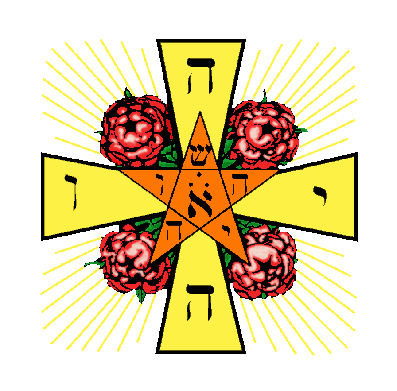 Like Papus our Ambelain saw the Martinist Order as a kind of outer organisation or stepping-stone which veiled hidden yet higher Orders and degrees. His continuation of the Kabbalistic Order of the Rose Cross of Papus was reformulated as a kind of occult school containing the pedigree of the world’s finest Rosicrucian currents, also given in four degrees:
- S.I.I
- C de Kilwinning
- Le Reau Croix
- La RC d’Orient
Each of these degrees is normally given at the attainment at higher levels of other Orders. Ambelain was the spearhead of the Martinist movement for some time. He even worked the Egyptian Rite of Memphis Misraim (Egyptian Masonry) from his home. Here we see again the Illuminism of Martinism closely aligned to the activities of the Egyptian Order. The main point is that before our present time ‘Martinism became larger than Saint Martin’ for many and became aligned to a series of esoteric movements, particularly the Rosicrucian current.
The Martinist & Rosicrucian Connection
Many people today consider the Martinist Order as a separate Order from the Rosae Crucis. However something quite interesting happened in 1962 at the official “Protocols of the Union of the Martinist Orders” where we read the following statement:
“Whereas, it seems clear, from a document found in the archives of the M.O.E.C, that Papus was the only one of the Supreme Council of the M.O, whose filations came direction from a branch of the Rose Croix, which was the common source of the 18th Century Martinism, and of Louis-Claude de Saint Martins’ particular movement known as the Rose-Croix of the Orient.”
Essentially, here the Rose Croix d’Orient is seen as a pre-existent Order, before Saint Martin’s time, and the claim is that it is the source for LCM’s inspiration. In fact other statements describe it furthermore as the source for LCM’s first master Pasqually, which would inspire his Cohens Order. Thus, there is an oral tradition or some myth making within Martinism that squarely places the M.O within the realm of Rosicrucianism.
I describe the Rose Croix d’Orient in more detail in my original Martinist Order Review. With the Rosicrucian-Martinist connection established we can now commence our review:
Martinist Order Trinosophia Score
The first score examined in this Rosicrucian Review is the Trinosophia Score. The word means “Three Arts of Wisdom.” The manifestos specify the paths of Alchemy, Cabala and Magic as being the true arts of the Rosicrucians.
In terms of Trinosophia, Khunrath was a big influence here seeing that before the publication of the Rosicrucian manifestos, in the 1600’s, his work describes these three arts as the true agencies towards regeneration. His symbols were also the Rose and Cross and he drew geometric talismans for seven sided cities which would later become symbolized in the seven-sided tomb of Christian Rosenkreuz. However, the word Trinosophia itself was coined by Cagliostro or Saint Germane.
Here is how the Martinist Order stacks up in terms of their Trinosophia Score.
For Cabala, Alchemy and Magic the M.O could get ten points each for a potential total of thirty.
Martinist Order Cabala Score
Martinist Orders are light in approach to Kabbalah, as say compared with Orders that are heavily Cabalistic. However the teachings are there and I find such an approach much more practical as opposed to other systems which get the student far too bogged down in occult learning. Most Martinists agree that mysticism is about life. The heart should show itself in works.
That being said, even if Martinism appears to be lacking a strong Kabbalistic transmission – the teachings of L.C.M himself possess advanced ideas worth years of revisiting. I should also point out that the Kabbalistic Order known as the “Asiatic Brethren,” while it taught advanced Cabala, it in fact borrowed whole sections from LCM’s writings for some of its higher degrees.
AMORC’s section of Martinism known as the Traditional Martinist Order (TMO) teaches Cabala in its monographs, as do Martinist monographs coming out of Canada. Unfortunately what they do teach is nothing other than readily available material already published in book form by various authors on Amazon. Then again, saying however that Martinist Orders do not have unpublished Qabalistic teachings would be wrong. There are several stations in the temple layout that have a Tree of Life arrangement…
Not all lineages possess this teaching. This particular gem is quite valuable in that it appears to be a backbone Cabalistic matrix providing power centres to the temple currents. What’s more I have found examples of this matrix within other branches of Peladan’s Belgian Rosicrucian manifestations, meaning that there is a Rosicrucian undercurrent to the Martinist temple.
Then again, several Martinist Orders have “no official teaching,” which is the preferred approach amongst those who strictly follow the internal way of Saint Martin. Members are left to explore related avenues for themselves. Generally speaking when the Tree of Life is covered, it is covered lightly.
However, the Fall of Man mythos is Cabalistic, and several branches go into this at length. This starts with Pasqually through his doctrine the Reintegration of Beings.
Here, Adam is seen as universal being, an over-soul champion of the universe. His “fall” was not like that described in the Bible but was a cosmic event. His breaking was the true cosmic catastrophe, the many parts of the broken giant over-soul becoming the wayward souls of the human race. Saint Martin depended on these ideas and various Kabbalistic lineages observe them very carefully, utilizing advanced formula of interpretation.
In the realm of Martinism however the mythos itself is of primary of importance in its mysticism.
Pasqually and Boehme were quite clearly both initiates of the Kabbalistic tradition. Saint Martin’s rendition, although simplified, still remains a chain of this Cabalistic teaching. Saint Martin becomes an advanced study is in his own right, when examining his Theosophy, which requires a lifetime of study. In many respects it is its own Qabala. Not to mention that his master Boehme is even more advanced for dedicated seekers. The mystical tenets of both however are simple; LOOK WITHIN, engross yourself in prayer.
As I have already reiterated, in approaching Martinism there is more than just Saint Martin. Not everyone looks to their founder because the “church has a mind of its own.” Several Martinist Orders employ the teachings of either or both Pasqually and Boehme, or the Martinist Order outright serves as Outer Order to bodies that do teach more advanced Cabala, including the Kabbalistic Order of the Rose Croix and the Elu Cohens, which in reality is a Catholic-come-Cabalistic magical movement. This is especially so, because in the Cohens you are trained along the lines of the Hebrew patriarchs to become a prophet. Therefore, even if traditional Kabbalah is not taught in full, certainly the transmission given to initiates in the Cohens is a Kabbalistic one and is entirely deemed an Operative-Kabbalah.
Thus the Cabalistic undercurrent is there, if one is but pure of heart enough to access it. What I mean is that in many ways the Martinist Order, with such an empowerment and means to directly experience a connection, does not require any formal Qabalistic studies. One is expected to learn directly through gnosis and it is through direct mystical experience that one receives an internal Kabbalah delivered by the masters of the past, the guiding prophets and angels. In the Elus Cohens, one is given all the practical tools to do so.
Remember, the word “Kabbalah” means “To Receive.”
The Martinist Order is awarded 5/10 for its Cabala Score. This actually might be harsh seeing that the Cohens work is Operative Qabalah. However, as said many M.O branches do not practice the Cohens and frown upon it altogether. It all then depends on how you want to look at it.
Do you want to learn through studies or be left to actually mediate and experience gnosis? The Martinist Order does teach some Cabala, although lightly. Various groups will emphasize more, but there is no official Qabalistic teaching. The M.O could do just a tad better here for students.
Then again, this emphasis is brilliant for busy seekers. You get all the spirit without all the clap trap.
Martinist Order Magic Score
Martinist Orders do not typically teach “magic” as such. Being one of the Trinosophia elements described in the manifestos you would think it fundamental that every Rosicrucian Order teach alchemy, Cabala and magic without any excuses. Alas many M.Os do not consider themselves Rosicrucian.
Even in identified Rosicrucian fraternities we typically find magic lacking the most. Martinism does present a somewhat reasonable excuse not to teach magic though. Let me explain:
Firstly, LCM specifically wrote against it. But at the same time his objections do not apply to all forms of the operative way. Thus most Martinist Orders reject magical operations without any consideration to the full scope of his work. His complaints are mostly in contrast to his first master Pasqually and are against lower astral manifestations that may prove misleading towards magical Regeneration. As we know, Martinism is not just the teachings of Saint Martin. While Saint Martin at first appears to stand against magic his master Boehme has very distinctive theurgical qualities, such as in his work the Mysterium Magnum. As well, his “Way to Christ” resembles the Sacred Magic of Abramelin the Mage. Thus LCM must have referred to a lower magic when rejecting it.
Several Martinist Orders have returned to their operative roots though. The aforesaid mentioned leaders of Martinism opened the way once again for Martinist magic. Papus did his “Elemental Treatise on Practical Magic” and Ambelain did his “Practical Kabbalah.” His all-important “Sacramentary of the Rose Croix” has prayers taken from Willermoz and Pasqually. He says that these are connected to the Rose Croix d’ Orient Order. These books are operative grimoires with some influence from Eliphas Levi and Pasqually’ Elu Cohens work, which brings us to an important subject.
Some elements of the Elu Cohens workings are very dark, and grimoire based. The magic circles are carefully drawn under special lunar nights, Hebrew letters are key and Latin prayers are used to consecrate the sacred space. The goals of the workings are quite clear. They adhere to the doctrine of the Fall of Adam and in using such rituals Martinism aids the operator to “Reintegrate with the Original Primordial Adam.” Doing one magical operation after another, the ladder of spiritual entities is contacted and called to raise the initiate. The operator works up through the order of beings, starting with lower spirits, climbing to the celestial hierarchy, until ending with God.
Blasphemous as it may sound, one of the evocations called into manifestation YHShVH! The very thought of it repels some Christians, excites the Cabalists and to me makes sense.
Such an evocation or materialization of Christ is the ultimate climax of initiation. Here, Christ restores one to paradise, impressing upon the initiate an ever-lasting fiery spiritual regeneration. As a magical theurgist I have to say this operation is DARING for want of better words.
As some have pointed out, while rejecting the theurgy of Pasqually our Saint Martin instead used a different term, being “Magism of God.” Just look at his letter to his friend, Baron Kirschberger:
“…There were precious things in our first school. I am even inclined to think that Pasqualis… had the active key to all that our dear Boehme exposes in his theories…. From all this, it follows that an excellent match may be made by marrying our first school to our friend Boehme. This is what I work at; and I confess to you candidly that I find the two spouses so well suited to each other that I know nothing more perfect in its way….”
–Letter XCII, 11 July,1796 in Theosophic Correspondence

Thus, Saint Martin himself quite clearly described a merger between the operative workings of the Elu Cohens and the teachings of Boehme’s Theosophy. As already shown, Theosophy is in every way a mirror to the Rosicrucian doctrines. Saint-Martin also writes in “Man His True Nature and Ministry” that “this work is the Magism of God, and the compliment of prayer.”
Thus magic appears the original teachings of not only Saint Martin but also Boehme, and here by “magic” I do mean divine magic, also termed as sacred magic or theurgy. Though not all Martinist Orders see things this way many members will apply themselves to some extent. Several Martinist Orders do invoke angels or practice with the 72 seals of the Shemhamephoresch. A few Italian branches of Martinist actually practice the Arcana Arcanorum.
Thus the Martinist Order receives 6/10 points for its magic score. Some branches being only meditative or chivalric play against the score here. The ones doing the Cohens work raised it.
Martinist Order Alchemy Score
The presence of alchemy is also worth a potential score of ten points and we look for this in any Rosicrucian Order under review.
Within the realm of Martinism alchemy is a “hit and miss” subject. Some groups avoid the subject entirely and others have some very strong alchemical traditions present. But for the most part Martinism remains a school of mysticism, touching upon the above ideas of Cabala and Theurgy, perhaps to the exclusion of alchemy.
There are however sprinklings of alchemical references in the M.O rituals, particularly in the second degree. Some of those hints steer the initiate towards the mystical work of the R.C d’Orient, and in this case alchemy is pointed towards for higher adepts.
The colours of the three degrees, black, white and red also show the rituals follow the three phases of transmutation; Nigredo, Albedo and Rubedo. Here the candidate undergoes alchemical transmutation and becoming a Philosophers Stone through initiation.
Some branches of the M.O have done quite well in establishing alchemical teachings either within their M.O grades or within a higher inner order. Thus, the hints given at lower degrees come to life in full when a Martinist is invited to join the inner order.
The M.O branch known as “Les Freres d’Heliopolis” or the Brotherhood of Heliopolis is said to have been led by the legendary Fulcanelli. This group was a small unit, as we would expect from practicing alchemists. I have personally encountered this particular lineage of the M.O and can vouch for the seriousness of their alchemical studies. The writings of Fulcanelli are studied religiously, as are the works of Paracelsus and members are required to generate enough financial wealth in order to retire early and spend years in pursuit of the Philosophers’ Stone.
Another branch of the Martinist Order pursues the cinnabar path of Roger Caro. At first known as the “Temple Initiatique Alchemique,” this Order was renamed the “Freres Aines De La Rose+Croix” or otherwise Brotherhood of the Rose Cross. According to Roger Caro’s son this Order has not revealed itself since 1972 and has gone underground in accordance with Rosicrucian tradition. It’s degrees are interesting and each relate to an Egyptian deity. Some Martinists use the FAR+C as their Inner Order.
Even better, one Martinist lodge named CINABRO has the best of both above traditions. Its founder, Toussaint, implemented both paths in his Order of Hermes and Orpheus. In the United States of America it is known as the “Martinist Order of the Knights of Christ” as headed by Sar Zohariel.
Lastly there is an alchemical M.O that blends Martinism with the traditional history of Cagliostro! This branch was supposedly formed by the disciples of Eliphas Levi and named the “Ordine Martinista Napolitano.” One of their members, named De Servis based their teachings upon the famous Arcana Arcanorum, also known as the Scala Di Napoli. This A.A system uses quite a lot of alchemical language. And although it does not stem from Cagliostro in reality, it is a mystical form of internal alchemy.
The A.A is typically used by the various Egyptian Rites of Masonry, aka Memphis Misraim, appears in some Belgian Rosicrucian Orders, as well as a few Hermetic brotherhoods. In many countries having the A.A means that the society is a “real Rosicrucian Order.” Recently in Sweden AMORC actually tried to buy a copy to obtain it for themselves. This was rejected, of course.
What we are seeing here is that some M.O groups claim to be Rosicrucian either through adding the R.C d’Orient or the Arcana Arcanorum as their inner orders. For many, Martinism is often a kind of “blank template” for leaders to teach other transmissions.
This is also why generally speaking Martinist Orders largely DO NOT teach alchemy. If they touch upon it their teachings are normally of a symbolic alchemy at best.
Pushing forwards an alchemical approach for Martinism, Robert Ambelain stated that he published his book “Spiritual Alchemy,” because not all M.O branches would have access to the higher way.
As he relates, his spiritual alchemy book is also derived from the R.C d’Orient. In his book alchemical components are given a mystical approach, for example “prayer is the alchemical fire.” He also claims in this book that the R.C d’Orient is also the inspiration behind Pasqually and his “universal Reintegration” and then later they instructed Saint Martin and inspired his “individual Reintegration.” Thus the R.C d’Orient is the true inner order for many Martinist.
The book features diagrams with alchemical triangles that overlay the seven virtues and seven vices over the qualities of alchemical gold, silver, and the three principles of sulphur, salt & mercury.
The system shows that as we descend into the reverse triangle, into the vices, we undergo alchemical putrefaction or darkness.

What I find important in this teaching is the reference to the descent of the Gifts of the Holy Spirit in relation to embodying the seven virtues by the Adept.
As I often teach, the spiritual powers of the saints are granted to the measurement of our grace.
Ambelain’s work, though heartfelt and great reading, still shows the extent to which most Martinist groups will study alchemy… not very much!
Unfortunately, for anyone who understands alchemy, Ambelain’s work is something of a premature attempt. It is helpful and lovely. But the major phases of alchemy are ignored. There are just better forms of spiritual alchemy available.
The good news is that Ambelain actually quotes the real star of Martinist alchemy:
“There is no real difference between Eternal Birth, Reintegration, and the discovery of the Philosophers Stone.’ Jacob Boehme.
Jacob Boehme was very alchemical, and this offers a certain flavour for what Martinist-alchemy should be, meaning; it should be a mystical-form of alchemy IMHO and not lab work. What Boehme does for the alchemical works is transform the figures of the Doctrine of Reintegration into alchemical phases. We relive the suffering of the Fallen Adam through repentance, which descends us into alchemical darkness, or otherwise putrefaction. The New Will we acquire is the Second Adam or Mercury.
In alchemy, the Mercury should go through several distillations, rising and condensing again. This is where the New Will for Boehme needs to surrender to the higher, and “die every day” according to his mysticism, thus a mystical alchemical distillation takes place. Boehme teaches a living alchemical magic. Unfortunately, many Martinists settle for Saint Martin and never get to Boehme.
Thus, considering how closed off the above alchemical branches of Martinism are, it’s safe to say that about 90% of Martinist Orders do not study alchemy, and when they do they barely touch the surface. Martinism however is largely intended to be a mystical Order and they successfully embody that idea above all others.
At the same time they are one of the Rosicrucian Orders, and if we are to view them as a very real living manifestation of the R.C brotherhood then the Martinists need to do more in this area.
The Martinist Order is awarded 5/10 for its alchemy score. In terms of the Rosicrucian Pillars, the Martinist Order misses the mark because others do it better.
And now, finally:
In total the Martinist Order gets: 16/30 for its Trinosophia Score
This particular score was hard to place, seeing that the Martinist world has bodies that swing between extremes, either undertaking tons of magical-theurgy work, and practicing very high arts of alchemy, all the way down to bodies that possess no teaching at all, at best just doing one or two meditations calling it the “Inner Way.”
Without any official teaching we are left to score in the middle of the whole spectrum.
Martinist Order Pansophy Score
The second aspect under examination is the Pansophy Score.
This section examines elements of the Rosicrucian manifestos most Orders entirely ignore. However, Martinism does quite well here, far better than the Golden Dawn Review.
Pansophy has three scores: The Utopian Score, Social Reformation Quest and a Universal Schemata Score. Each is worth a potential 10 for a maximum of 30 points.
In addition to this, we also look for a fourth element, known as the Maiden and the Sprig, which is an essential element of Pansophia and the early Rosicrucian movement. In our scoring system you saw this as the Pansophic Sophianic Deliverance.
Martinist Order Utopian Vision Score
Martinism successfully embraces some elements of Pansophy and here they win positive points.
I’ve already mentioned the importance of Campanella’s “City of the Sun” and how such a utopian vision was extremely important to the Rosicrucians. It wasn’t just about occultism after all.
Where this all comes into play in Martinism is in its references to the “New Jerusalem,” which is well known in Christian mysticism.
However, where the real light of this utopian notion shines in Martinism is not in regular Martinist branches as established by Papus, but instead is to be found in its other branch – the C.B.C.S.
I’ve already gone into detail regarding this Order in my original Pansophy Score of the Martinist Order. To recap, in French it is called ‘Order de Chevaliers Bienfaisantes de la Cite Sainte’ abbreviated as C.B.C.S. This Order was established by Jean Baptiste Willermoz, a student of Pasqually, in 1778.
Thus Martinism is said to be made up of three branches; the Elu Cohens of Pasqually, the C.B.C.S and the Martinism of Saint Martin and Boehme. Together they are called Martinezism.
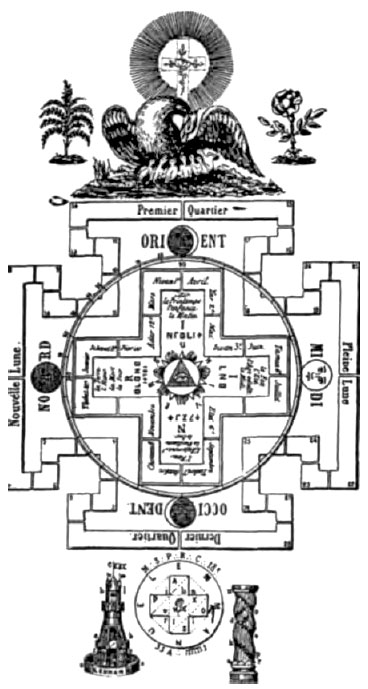
Central to the knighthood of the Willermoz tradition is the Temple of Jerusalem. Like all Masonry they are builders of humanity, and work towards the Temple of New Jerusalem as well. The “Knights of the Holy City work for a society where all men can unfold themselves, and seek the sacred way they desire, in harmony and peace with each other.” This ideal is very similar to the attributes given in Campanella’s City of the Sun.
However, not all Martinist Order organisations embrace the C.B.C.S. Some totally ignore it.
This is a shame because it automatically links to King Arthur, Camelot and all of this is closely tied to the utopian quest of the Rosicrucians. King Arthur is covered under the Pansophic umbrella.
On the downside for Martinism, Pansophical utopian models do not merely describe an ideal way of living. They are also caught up in the notion of divine architecture. Masonry does this well, the C.B.C.S raises the score somewhat, yet it is just not Pansophic enough. Consider that the Hartlib Circle, as a Pansophic and Rosicrucian body, designed the sun palace and gardens of Versailles in France. They actually built a living model of Campanella’s City of the Sun, complete with tributes to Apollo and Venus.
So in contrast the Martinist Order, while having at least one utopian vein, still does not encapsulate the full scope of what Pansophy has to offer. This quote explains what we are looking for in this section of the Rosicrucian Review;
“The ‘future’ city finds its inspiration in a philosophical, psychological and/or sociological concept, and its aim is to determine a living place for a new society in times to come. The visionary thinker looks ahead, see things, and anticipates the unexpected. The concept of a future city must include all the best of the present, which will be projected towards unknown ages.” Binghaml, 2004.
The vision for a future utopia in Saint Martin is scant at best. But there is a solution.
My suggestion to Martinist Orders, should they wish to expand their horizons and mirror the Rosicrucian model; why not embrace the teachings of the C.B.C.S as well? Some Martinist Orders, some groups certainly have done so. Not only that, there are a couple of Martinist Orders that closely observe the architectural mysteries of Fulcanelli. Had the Martinist Order included a City of the Sun diagram in one of its degree rituals, we would be looking at possibly the strongest Rosicrucian tradition on the planet.
When measured against the Rosicrucian tradition, the Martinist Order is lucky to have the C.B.C.S.
The Martinist Order receives a full 6/10 for its utopian score. Not bad at all.
Martinist Order Reformation Score
The Rosicrucians did not only draw upon the City of the Sun models. They also created ideas that would help implement the utopian movement throughout society, bringing us towards the goal.
This is where the overly idealistic vision of the utopian facet becomes pragmatic.
The Martinist Order itself does not approach Pansophy officially but it has a mystical approach to reformation. Its best demonstration is shown in the “Operative & General Ritual” used by all Martinist Orders. It is a ceremony held by Martinist around the world for the elevation of souls and aid to the sick. The aim of the ritual is to “unite their efforts by working together, at certain monthly periods, on their common work, the Universal Reintegration.”
The prayer done in unison by Martinist around the work request divine intercession for:
- The peace of the world.
- That humanity shall be preserved against elemental disasters.
- Against illnesses and plagues.
- The nourishment of the fruits of the earth and its fertility.
- The blessing of wandering souls.
- Re-illumination of souls lured into darkness by materialism.
- Prayers for the sick, afflicted and prisoners.
- The blessing of the heads of Christian and non-Christian nations.
- The elevation of fallen spirits in the vegetable, mineral and animal kingdoms.
- The exorcism of the influence of demons.
It’s all very nice stuff, however, Pansophist did not deal with reformation through occultism. Without practical models, such as architectural plans or the reformed education models the Pansophists proposed, we might consider such occultism merely hopeful verbiage. Certainly it is nice to have a ritual channel, but we’re looking for something more pragmatic. If the four worlds of the Kabbalah teaches us anything – it is that the ideal of the highest world must become manifest in reality.
Rescuing its Rosicrucian elements, Louis Claude de Saint Martin did in fact address the problem of arriving to the City of the Sun, although not under those words, the principle is the same.
In his work “Considerations of Politics,” 1794, Saint Martin describes a mystical understanding of the French Revolution, in which he found himself. In it he also turned to addressing political problems, developing several occult theories which describe an enlightened leadership. He said:
- The will for community reflects our true higher nature.
- Strife/wars against community are reflections of our fallen state.
- That we find strife unhappy proves that discord is unnatural to our divine nature.
- The French Revolution was a rebalancing of community back to a more natural state.
- We are the divided sparks of a fallen divine being, the Universal Adam.
- This is why there is a General Will which may bring community harmonization.
- Individual wills are not the starting point of social order, which creates a paradox.
- It appears individuals either give up independence or have it taken away in community.
- But never will the General Will form itself from particular wills.
- On the contrary, it is the Particular Wills which must form themselves form the General Will.
- The General Will is the unique source of the divine thought of Reintegration.
- The very existence of social formation points to a fundamental original order.
- The goal of human association therefore must be the recovery of this higher unity.
- Thus its guiding force cannot be drawn from political elections, seeing that these are drawn from a myriad of conflicting desires and parties from the division of Particular Wills.
- In fact, having political parties for election can only lead to social devastation.
- Political leaders claim to announce the divine General Will, which is impossible.
- Instead they have to be a ‘reflection of a power superior to them.’
- Therefore the legislator must be impregnated with spirit and life.
While not describing the design of the City of the Sun, he makes it quite clear he is speaking of the same Priest-King class which governs it from the central temple as described by Campanella, who wrote “the great ruler among them is a priest whom the call by Hoh, although we should call him Metaphysic.”
This, coupled with the influences of Bohemian Theosophy, makes for rich soils of further study. Unfortunately, I have yet to come across any Martinist Order that actually teaches these Pansophic aspects of Luis Claude de Saint Martin. Most groups are just focused on his occultism, which is typical in Rosicrucian Orders as well.
Adding to weight to the Reformation Score of the Martinist Order is the Synarchy system established by French occultist Joseph Alexandre Saint-Yves d’Alveydre (1824-1909). Synarchy literally means “Joint Rule.” Saint-Yves used the term to imply several things in particular:
- Synarchy implies Government by an Enlightened Elite. The Elite themselves of course decide on what Enlightened means. There is some risk for several issues here, however.
- Synarchy implies the opposite of Anarchy. Whereas in Anarchy the state should have minimal controls over individuals, in Synarchy the state has maximal control over every aspect of individual’s lives. Zero freedom in all spheres.
- Synarchy comes neither from the Right or the Left; rather it consists of the Totalitarianism of the Centre. In practice, most of its adherents are more to the right.
- Saint-Yves proposed that a secret society of the Elite should rule through three main stations of social control: Political, Economic and the Religious institutions.
Saint Yves envisaged taking over first France and then creating a Federal European Union, and then perhaps a One World Government. They wanted to create a classless but Profoundly Hierarchical state, or mega-state, run by Elite Technocrats of neither the right nor of the left, but simply “enlightened” leaders who know best. Every aspect of life would be controlled by this class of rulers.
Personally, I am not a fan of the Synarchy system. Many Martinist embrace it. It is quite a problematic issue and in my experience those who follow the ideals of Synarchy are often, sadly, bigots. That being said, it is clear the Martinist did not ignore the utopian and reformation aspects like the Golden Dawn did.
The Martinist Order receives 6/10 for its Reformation Score.
For some this might seem low. However, followers of Jacob Boehme certainly established their own utopian communities in America. In fact, John Winthrop, a member of Samuel Hartlib’s Pansophic Circle was right at the foundations of establishing America as a new utopia. Also, consider the fact that Pansophists advanced their utopian quest through architecture and reforming education. Steiner did a fine job on delivering an education model for example in his Rosicrucian stream. The other problem of models like Synarchy, is that no matter the group, those using it assume that the “Ruling Elite” would be themselves, of course.
Martinist Order Universal Schemata Score.
One of the most misunderstood subjects of Rosicrucian Pansophy is that of the universal schemata, which embeds cosmic model ideas into the structure of the Rosicrucian Order.
Here, the macrocosm is presented in the microcosm. The Rosicrucian Order itself becomes a living breathing vessel which transmits knowledge and science pertaining to all things, thus it becomes not only a model of the universe, but is also a revelation of reintegration and regeneration at the higher spectum of human learning, starting from childhood, through adulthood and leading towards adepthood. It is a living model of the universe, whilst at the same time a wheel of education and self reflection.
This idea is not at all new. Careful examination of Campanella’s “City of the Sun” shows it not only describes a harmonious society living in the grace of the light, but that society itself is set within an architectural structure, which itself presents images of science and the knowledge of Nature. The Rosicrucian tomb is similarly a compendium of knowledge, a Pansophic Theatre of Memory. Campanella’s City of the Sun is also engraved with an encyclopedia of all life forms on its walls.
Thus, what we are looking for in Pansophy is that the Order itself should be a teaching device, as well as a cataloguing system or compendium for recording all discoveries and knowledge. This catalogue or schemata must also be tied to a universal Reintegration myth. We do set a higher standard here at Pansophers.
The Martinist legend in the “Treatise on the Reintegration of Beings” by Pasqually by all means is very Rosicrucian. It lacks the Sophianic aspects we are looking for in Pansophy, however.
The universal attribute is troublesome. There is no official model of the universe used in Martinist Orders. For example some refer to the “Universal Table’ of Pasqually and Saint Martin. Clearly this is not your standard Cabalistic Tree of Life, although some ignore Pasqually’s model and use Qabalah instead.
Several Martinist Orders do use the Cabalistic Tree of Life model in the temple, discretely. In its temple use, I cannot share due to oaths, I would say this approach has been present since Papus. This has to do with the layout of the temple furniture and temple floor.
There are also five degrees proper to the Martinist Order, which may or may not, depending who you ask, correspond to the five circles upon the middle pillar of the Tree of Life.
Thus the third degree truly is “Rosicrucian” being the initiation of Tiphareth in its solar nature. The higher Unknown Superior classes then belong to Daath, the realm of hidden knowledge and Kether.
| Degree | Tree of Life |
| Associate | Malkuth |
| Mystic | Yesod |
| Unknown Superior | Tiphareth |
| Unknown Superior Initiator | Daath |
| Free Initiator | Kether |
Of course the final degree is quite recent, as an evolution upon the Papus system by Ambelain, making it something of a stretch, yet the Order of Martinism itself is an evolving and recent thing. Papus and Ambelain worked to include several Rosicrucian currents, providing a base in which to study alchemy, magic and Cabala, broadening the range of Martinism to something truly Rosicrucian.
Still, Pasqually, Saint Martin and Willermoz did not use the Tree of Life model. The Universal Table truly is the proper tool to understand the “Reintegration of Beings” and the number system of Pasqually.
Either way, Pansophical instruction diagrams should be present in the temple rituals, and the temple should be arranged in that universal model, whether of the Tree of Life or Universal Table.
Every point and place of the temple whether a throne, sword or altar, should be carefully placed and arranged according to that model. At the same time the temple needs to become a teaching device, dispensing sacred knowledge by its very design, reflecting the same ideas of the City of the Sun and the Tomb of Christian Rosenkreuz. Clearly there is room for development.
The Reintegration Legend boost the score here, but the lack of a Universal Schemata as a teaching and a strong Sophianic element brings it down somewhat.
In between these two, the Martinist Order gets 5/10 for its Universal Schemata Score. It has all the potential but (Rosicrucian wise) doesn’t pack its final punch.
Pansophy Conclusion:
Utopian Vision Score: 6/10
Reformation Score: 6/10
Universal Schemata Score: 5/10
Total Pansophy Score for the Martinist Order: 17/30
Martinist Order Christosophia Score
Now we get to where Martinism scores strongest. Without doubt, the Christianity of this Order scores well compared to other groups in my Rosicrucian Reviews. In my original 2015 Martinist Order Christosophia Score I made a point of comparing Rosicrucian-Christianity vs. Martinist Christianity, however. Those ideas still stand. There definitely are differences between the two.
Martinist Order Christ Symbol Score
Any Rosicrucian Order should depict a Christ symbol. This goes back to the manifestos, despite what some modern mystical R.C Orders say, Christ is definitely one of its main symbols.
Clearly Louis Claude de Saint Martin praised Christ. So did his master Boehme. For both, the mystical letters of YHShVH are important for mysticism. LCM refers to Christ as “the Repairer,” a title given as the main catalyst to Reintegration. The Martinist Christ though is not that of religious Christianity. In the realm of Martinism we find an esoteric reinterpreted Christ, just as Pasqually saw the Adam of Eden projected into a super Primordial Deity, which was split apart by a mystical fall from grace.
Saint Martin echoed the words of his master Boehme, saying that Christ had to be enshrined within the heart. Boehme resembled this concept with his tetractys of flaming letters. Boehme says that these letters must be written in the heart for practice. Thus there are hints for avenues for letter-mysticism as well. Not all Martinist agree that Boehme is at the core of their Order though.
In Martinism, the cross is a major symbol, as is the entire passion of Christ. In every sense, Martinism is Christian and some M.O’s only allow entry to its degrees of you are confessing Christian or of a particular Christ-faith.
I think the Martinist could have done with stronger Christ symbolism either in its mystical seal or rituals, for example the G.D actually does the crucifixion. There is an actual lack of Christian imagery in Martinist ritual. Even so, the Martinist Order receives 9/10 for its Christ Symbol Score.
This score is based upon Boehme’s influence in some quarters. Saint Martin also went into the Logos quite a bit, but interestingly separated it from Christ at one point. What I’d really like to see is a Christ symbol like the seal of the Secret Symbols of the Rosicruicans, as also used by the RR et AC. Had Papus used this emblem it would have scored a straight 10/10.
Martinist Order Hermetic Christianity Score & Against Gnosticism Score
The Rosicrucian version of Christianity as shown in the manifestos is highly esoteric. I’ve decided to review the “Hermetic Christianity Score” and the “Against Gnosticism Score” together to make things easy. Plus, here in Martinism the issued are very much interrelated.
The first score of Hermetic Christianity is worth a potential 10 points and the second can deduct points from Martinism if there are any anti-Nature sentiments or anti feminine indications.
I’ve been over it many times in other post. Apollo and Venus are figures that appear quite strongly in the scheme of the Rosicrucian manifestos. This is unavoidable. This is also why certain Rosicrucian Orders that require you to be a confessing Trinitarian Christian are partly mistaken.
Rosicrucian Christianity is “Hermetic-Christianity” to be exact. Be warned, quite a few “Rosicrucians” will ignore the Apollo and Venus figures and try pass off their own Christian faith as suitable.
This is especially so for Gnosticism, which his just not compatible with Rosicrucianism.

Fortunately, the Christianity of Martinism; it certainly is NOT regular Christianity. It is based upon both Boehme and Pasqually. The second of these two is responsible for the endless tirade concerning the consequences of the Fall of Adam. It is blamed for everything and is the reason for all suffering. The cosmology creates a kind of justice-view for later salvation through the Repairer.
If Martinism depended on just Saint Martin though, I’d have to lower this score. Some of his Christian writings are nice: “Hope is faith beginning, faith is hope fulfilled, love is the living and visible operation of hope and faith.” I find this refreshing and it seems to identify the character of how initiates should appear at each of the three Martinist Order grades… BUT, at the next turn Saint Martin says that we need the Virgin “only” to give birth to Christ within and not the Logos. ONLY he says. And here he separates the Logos from Christ, which is a strange move in Theosophy.
The other important element that separates the R.C from regular Jesus-folk is the Rosicrucian reverence of Nature. The Rosicrucians had two books, the Light of Grace (Christ) and the Light of Nature. Actually the Rosicrucians put the Book of Nature above the Bible! (see the Pegasus of the Firmament for proof).
Saint Martin says; “All the impressions which are made on us by Nature are designed to exercise our soul during its term of penitence, to prompt us towards the eternal truths shown.’”This fits nicely, but then Saint Martin shoots himself in the foot. He all too often imposes “Man’s Superiority and Dominion over Nature.” The Rosicrucians though thought nature was God revealing. Sometimes LCM does not disappoint and comes close, saying “Nature and the Scriptures should be compared.” Alas it just isn’t the same as Paracelsus intended. Boehme, like the Rosicrucians, saw that the Word may be received directly from Nature, and that Nature was a living writing of God. We see here echoes of certain figures like Saint Francis of Assisi and Saint Bosco’s and his hound.
In short, Saint Martin’s Christianity is not exactly Rosicrucian. If you take the Behmist route though Martinism is restored in its Rosicrucian flavour. Consider how for Boehme Christ is to the soul what the sun is to the universe. He describes the Trinity through Nature; God is the beyond, the Holy Spirit the space between, and Christ the sun, which we see in a living tree, whereby “God is the trunk and body, the Holy Spirit the scent of that tree, and Christ the sap.”
Thus, Boehme is where all the real brilliance of the Martinist tradition shines. Indeed his ideas and model are identical to the Rosicrucians. Everything about Boehme IS Rosicrucian. But, can we score Martinism based on Boehme though? Definitely not as too many restrict Martinism to just Louis Claud de Saint Martin, and if you are lucky they also look at Pasqually.
The Martinist Order receives 7/10 for its Hermetic Christianity.
The Martinist Order is deducted 3/10 points for its Against Gnosticism score.
In total the Martinists get a total of 14/20 for their Christosophia Score
I should actually deduct one point away from the Hermetic-Christianity score. There are not enough Hermetic archetypes speaking through the visionary brilliance of LCM. There is no Apollo or Venus at all, and we are dealing with a ROSICRUCIAN review. Not that of Martinism in general.
To be clear, the Christ and Sophia of LCM are quite Rosicrucian. I’ve said it many times before though; Gnosticism is a poor substitute for Rosicrucian Christianity. They are just not the same. This is perhaps one of the finer differences between the French and German occult schools. The Germans developed Panentheism where the French went quite strongly into the Gnostic Church revivals. Although, if we got into the Gnostic Church side currents of Martinism, we’d have to deduct more points.
Martinist Order Wildcard Score
In my reviews each Order has the chance to win an extra twenty points based upon any additional elements that help strengthen its Rosicrucian traditional value. Beyond the scoring system there are still aspects of the manifestos that when drawn upon help establish an even more traditional basis. These qualities are not required within my scoring system, but several Orders touch upon several ideas that other Orders skip over. The BOTA for example really focuses the idea that the Tarot truly is Book T as mentioned in the Fama. Some Orders take other aspects further.
There is one thing the Martinist Order does something extremely well. They capture one particular quality contained within the manifestos better than any other Order.
It has something to do with invisibility.
Consider how Saint Martin wrote his books under the pseudonym “the Unknown Philosopher.”
The highest degree of the Martinist Order is “Unknown Superior.”
Why is this at all relevant?
Most Martinists learn that this title, coupled with a mask, is provided to conceal our identities, which in turn helps suppress the ego, seeing that our persona becomes less important than the actual work at hand, along with the current being transmitted. In doing so, ego is minimized. This is not done so well in all Rosicrucian Orders.
For our review there is another layer to this, a very traditional one. You see, when the Rosicrucians first announced themselves no one knew who they were.
They were hidden, concealed and their invisible brotherhood transcended the need for social recognition. “If you are earnest, we will find you” they said. By their very publications, they moved in mysterious ways, invisible to the eye of the public. It is THIS aspect the Martinist do so well.
The titles Unknown Superior and Unknown Philosopher
perfectly embody the Rosicrucian ideal of being a Master.
A Master does not wish to be known, other than through WORKS
In keeping with the hidden identity concept the M.O succeeds here in manifesting another traditional element from the original founding Rosicrucian declarations. The very idea of being an “Unknown Adept” is completely different from the Golden Dawn’s “Adeptus Major” title, let alone its highest grade Ipsissimus, meaning “His Most Selfness,” which sounds more akin to megalomaniac.
In fact, if you travel the world of social media you’ll find that very few Martinist openly declare their membership. They nicely retain an element of “invisibleness” even there.
The Martinist Order receives 14/20 for its Wild Card Score. All Orders have something to learn here.
On the topic of the invisible aspect of Martinism, you may wish to check out a new book that recently released the First and Second Degree Rituals of the Order of Unknown Philosophers, of Arthur Edward Waite. This like a few other rare branches of Martinism embraced the Unknown Philosopher motif of Louis Claude de St Martin through Papus and was intended to operate as a higher circle which bound all higher degrees under one hidden body.
Final Total Score of the Martinist Order
Here are the Martinist Order scores for the final total:
Christosophia Score: 17/20
Trinosophia Score: 16/30
Pansophia Score: 17/30
Wild Card Score: 14/20
Total M.O Rosicrucian Tradition Score: 64/100
What Kind of Adepts is the Martinist Order Producing?
Unlike my Golden Dawn and AMORC Reviews, there is actually little to go on when measuring “Martinist Adepts.” The reason for this is you won’t see them in the open. If you do see a Martinist Order advertising itself, or a Martinist openly sharing their knowledge online in chat rooms etc. it is not typical Martinist behaviour and even frowned upon. Even recently a Martinist Order came into debate for charging its members for its grade volumes (only available to its members and sold only at production-cost price) seeing that the teachings of Martinist are to be given freely. They do like to remain behind closed doors and Martinism is always taught for free in real Martinist Orders. In my opinion having students cover their own printing cost for volumes is absolutely fair.
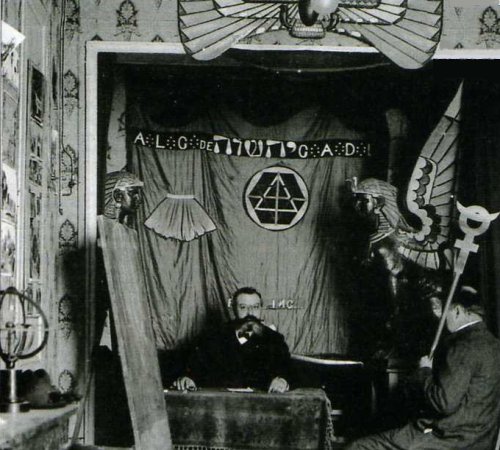
Papus in an early Martinist Temple. Note the early seal.
I would not class AMORC’s TMO members as typical Martinists either, seeing that they tend to cast Martinism aside as a “Christian side Order,” quite apart from the stream of “Rosicrucianism.” Then again, Martinism is one of the few Orders which acts well in the position of side-Order to nearly every org. Masonic R.C Orders have their own M.O. A few G.D Orders do as well. The Egyptian Rite of Memphis Misraim fits extremely well with its M.O side order, not only for its French currents. In some M.M groups its hard to see where Martinism begins and where it ends, so closely aligned as they are.
I do feel there is a lack of responsibility at present from Martinist adepts. Someone from the M.O world needs to step up and provide teaching volumes not only to their own closeted brand of Martinism (as they already each do), but to generously grace such to ALL Martinist Orders, fully allowing any branch to access them. Only then will Martinism show that it truly carries the mystical generosity of the Repairer, as they all claim. There is a tendency here to covet materials to one’s own clique instead.
You might be thinking I don’t like Martinism. No, that’s not true.
You should read my other post “Why All the Nit Picking of Orders in your Reviews?”
I should add here, one of the greatest graduations you’ll ever have, as a Rosicrucian student is breaking away from your own Order. Yes, I mean cancelling your membership, giving up your grades and throwing it all away. This might sound strange at first, even hurting, but you can see why here.
You’ll also find out if your brothers and sisters are as nice as you originally had thought…
In reality, for the most part, the spirit of Martinism outshines most Orders. You’ll see Martinists often visiting and comfortably partaking in the rites of other M.O Orders.
In most groups you can see the spirit of sharing occurs between Martinists nicely. Much of their learning is still transmitted orally, especially concerning views on various occult practices. Thus Martinist adepts tend to shape each other and groom each other towards higher understanding, whereas let’s say in the G.D members are immediately competitive and proud of their understanding. I’ve found Martinist to be quite sincere in their willingness to talk about their approaches.
As to the range of knowledge that is possessed by Martinist adepts, it begins with mystical light-of-knowledge types to those who are extremely scholarly in their field. Most importantly, both types are often seen to possess a mystical wisdom and kindness that is also not undone by those who have dedicated themselves to knowing the deeper history and facts of older Martinism. One thing is also for certain, Martinists are normally seen to have quite good jobs, stable lives and are not the type of people you’ll see at the OTO or Golden Dawn. I’d go so far to say that in one group drug use is a regular choice and in the other its frowned upon.
Does this mean that Martinism turns out more stable well-rounded Adepts? It may also mean that certain people are attracted to different types of Orders to begin with. Be aware of this factor, therefore, and ask yourself as well, how do you wish to turn out?
More Information
For those readers who wish to get deeper into my Ordre Martiniste Review, I based this review off my earlier reviews of Martinism. This review is an improved summary of my earlier findings.
However, there is additional information within each of the original blog posts. In particular, I have hidden many Easter Eggs regarding the nature of the Rosicrucian Tradition, scattered throughout all twenty post of my original Rosicrucian Reviews series. You can find the Martinist ones here:
- Martinist Review Part One.
- Martinism: Pansophy or Theosophy?
- Trinosophia Score of the Martinist Order.
- Christosophia Score of the Martinist Order.
- Pansophia Score of the Martinist Order.
- Original Conclusion to the Martinist Reviews.
- On the Gnostic Church and Martinism.
Martinist Order Review Conclusion
In closing I offer these final thoughts regarding Martinism.
Firstly, during my initial review of the Martinism in 2015 some expressed surprise that the Martinist Order would even be considered within my Rosicrucian Reviews. On the other hand, certain occult authors admitted they tended to look down upon Martinism as a lesser teaching, seeing it as “too simple” without realizing the great diversity it offers.
Perhaps some appreciation may now be given. Though, there are still many issues with Martinism.
For example, where some branches have veiled Orders above it, containing higher teachings, other branches of the M.O reveal those higher teachings within their three standard Martinist degrees. And yet other Martinist Orders possess the cream of European occultism. One has to understand that some Free Initiators merely use the Martinist Order as a vehicle for teaching highly potent unpublished Rosicrucian teachings.
The message here is, if you go looking for a Martinist Order near you, it may not have everything described here. Yet this kind of diversity and potency is what makes the M.O quite powerful. The quality thus depends upon the branch and the teacher. This means you can’t just say “The Martinist Order teaches XYZ.”
And this is where the occultists miss the mark in failing to recognize the M.O’s power. And make no mistake. The Martinist Order is a Rosicrucian Order.
We’ve already seen the “traditional history” concerning the R.C d’Orient; that LCM (founder of the Martinists) was said to be a member of the R.C d’Orient himself, and that this was the same movement that empowered his previous master Pasqually.
Thus the M.O in its oral teachings claims a Rosicrucian origin.
Here, we arrive to the notion of the “Secret Chiefs” of the Golden Dawn, seeing that it is thought that Unknown Superiors have quietly worked behind Martinism to support the movement, guiding, as they did, the hand of LCM, and all its leaders, all the way to Papus and the Martinists of the present.
One of your associations might be an Unknown Superior, never revealing his identity.
I would actually go so far to say that Martinism is more Rosicrucian than many Orders calling themselves “Rosicrucian.” Certainly here I mean more so than Amorc!
If you are looking for an Order to join, you certainly could do worse here, so why not give Martinism a try? Personally, I do not get anything out of Martinism. I find it quite boring. As someone who started with the writings of Jacob Boehme, it felt like taking a step backwards, as in many ways it is simplified Behmism. That is just me personally though. I could not deny it is a powerful vehicle for many ideas and is helping initiates around the world connect with their inner Light.
The Martinist Order has done very well in this review. In fact, it scored the same number of points as the Golden Dawn in its own Rosicrucian Review. Though, for very different reasons.
Certainly now, you should weigh up the odds and decide what is right for you.
This concludes the Martinist Order Review. If you want to change this score you’ll need to provide feedback and further points to help justify alternative views. I welcome any discussion and feedback. Bear in mind however that this is a Rosicrucian Review and only gauges its measurement against the R.C Tradition.
 Cheers for reading another of my Reviews of the Rosicrucian Orders. This completes part three of the five part series.
Comments enabled below!
Samuel Robinson.
Founder of Pansophers
Looking for the right Martinist Order? At Pansophers.com it is rare for us to recommend any specific group. The following Martinist body is rated as outstanding by Pansophers.com:
Two quality Martinist Orders we recommendinclude: MOUP and the BMO, depending on what you are looking for.




Interesting article, however I must take issue with your mention of Myriam and the OOE as having any correlation with St. Martin. As a Martinist Initiator and a member of both Myriam and the OOE, I can state with confidence that there is absolutely no connection (at least directly) between St. Martin and Myriam or the Order of Osiris. Of course, Myriam has been utilized by some French Orders (specifically Memphis-Misraim in France and certain Martinist Orders in France) as a kind of “inner order”. However, I’ve seen no evidence of a connection to St. Martin directly in any of this. Furthermore, every French iteration of Myriam I’ve ever come across only has a portion of the original lessons/practices, typically ending after the third circle of the Order, excluding the “higher” Alchemical teachings. Thus, in my personal and anecdotal experience, the French Myriam is an incomplete system, lacking several integral features and is not entirely in line with the original Italian academies. If indeed you have valid and irrefutable sources you can cite on this subject, I’d be very interested in hearing about them. Regardless, thank you for your efforts and for this article.
Hello bro,
Thank you for this feedback. I’ll get to updating this and reviewing all the information coming in asap.
It is interesting that for you its quite clear that the Myriam is an inner order in the M.M rites in France whereas in the M.M groups I’ve dealt with this fact is kept very hush hush. So I appreciate this kind of statement which clarifies something for a lot of our fans.
Best wishes in LVX Sam
The part about the MO initiates being the most genuinely kind and typically eschewing the drug culture appeals to me. Unfortunately the only Martinists I know are AMORC members and I have found that they are not very welcoming regarding any sort of genuine skeptical, walking question marks. They also seem to be shocked at the sight of a newbie who isn’t a complete ignoramus.
I spent decades following the Eastern style schools and I learned a lot. I eventually left when I looked around and had to admit that the methods being practiced did not work real well for around 90% of the initiates. About 10 years ago I turned my attention back to the Western Schools but so far I really do not see much to get excited about.
I like the ranking system used here. Well done.
Is there a ranking for “practical results” where Schools are ranked by the success of their methods and how well the standard run of the mill member progresses with the methods taught and practiced? (About 5% of the population will do well in almost any rinky-dink school and they are pushed into the limelight and paraded around as examples of the school’s efficacy but the reality remains that 90% of these pretend mystery schools don’t advance 90% of the membership fer squat).
I would like to know which Schools actually Work. And how is that measured? I am interested in True progress in the subtle realms so this is not a simple task.
Hi there mate,
That’s a fair question. I’d like to rank effectiveness, but I’ve got radically different ideas on what is fantasy vs. what is a system confirming initiation, which many will not be very happy about. There is some child’s play going on in the realm of “enlightenment” and visions and such, where people can get carried away with their own importance, which in those systems is considered “success” and whereas in others it might totally fall short of awakening to the Logos. I see that such a notion (valuable initiation and results) really needs to be overhauled from the ground up, in terms of what is acceptable and what is fantasy. This in itself is a massive project.
I feel we’ll get to that soon. The reviews was phase one. The next phase is rolling out practical R.C methods on this blog.
Thanks for raising this important issue, Sam
Thanks for the rapid reply, Sam. I trust your judgment in how to rank effectiveness based on how well you have done with your ranking methodology so far. I don’t agree with you on everything but that is okay. Just getting your perspective has a LOT of value and as I read more of your site I get a better feel of your paradigm. I can glean more than a few useful tidbits with this understanding.
I think it is rather weak for readers to complain about things like, “Ohh, how can you judge spirituality” type issues based on a difference of opinion of what “spiritual” means. They are missing the point. Once we understand how you use the word we are able to gain from your perspective. Agreement is not a prerequisite when we are just sharing perspective. One of the marks of an Initiate making progress is the development of a posture of freedom granted to others to operate according to their own choice and preferences.