The book known as the Secret Symbols of the Rosicrucians of the 16th and 17th Centuries contains several illustrations relevant to Rosicrucian mysticism and history. Published in 1785, in Altona, Germany, the work is often associated with the Orden Der Gold -und Rozenkrezuer (The Order of the Gold and Rosy Cross). The order was in its prime during these years. The book features many images borrowed from Jacob Boehme, Daniel Mogling, Valentine Weigel, and others; ideas taken from individuals who were closely aligned with the same pietistic and alchemical character that would describe the order some nearly two centuries later.
In an earlier article on Pansophers [Origins of the Secret Symbols of the Rosicrucians] Christine Eike offered a close inspection of this important work as well as some of its prototypes. Her article showed that the Secret Symbols was initially planned as early as 1766 and held the working title of The Teachings of the Rosicrucians from the 16th and 17th Centuries. Her article also compared the work to the well-known D.O.M.A. manuscript, a text brought to wide attention by Manly P. Hall in the early 20th-century. Many images from pages found in the Secret Symbols first appeared in the D.O.M.A., suggesting it was the inspiration for the former or a kind of prototype. Some scholars have dated the earliest production of the D.O.M.A. manuscript to the mid-17th century.
Recently, however, another curious manuscript has come to attention. This work, titled Gemma Sapientiae et Prudentiae, was produced circa 1735 in the German language. Previously unmentioned on Pansophers, this work, translated as Gems of Wisdom and Prudence, also contains some illustrations that would appear to have influenced those later found in the Secret Symbols. A closer inspection of the two manuscripts reveals some striking similarities.
A few years ago in the Rosicrucian Tradition group, Stephen Murtaugh shared a document showing six illustrations found in the Gems of Wisdom compared side by side with those found in the Secret Symbols. We will take a close look at these same images and try to uncover some of their meaning.
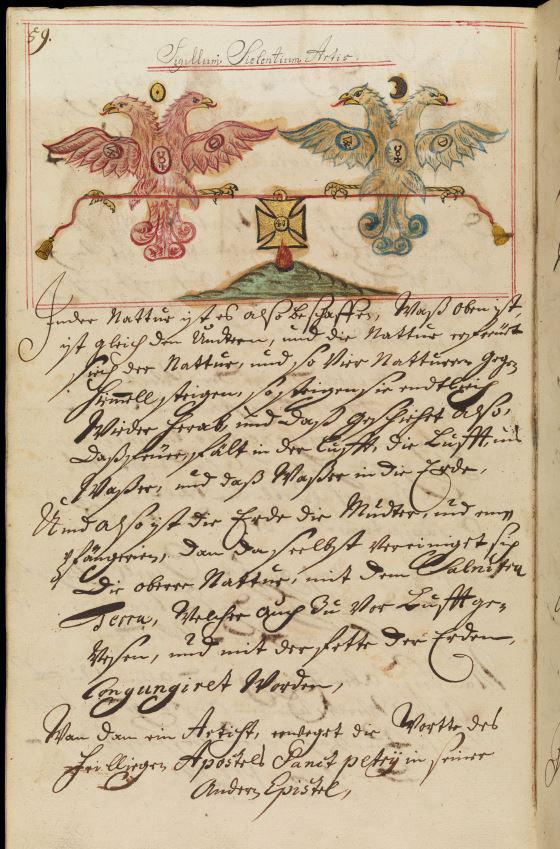
Beginning with the illustration on page 59 of Gems of Wisdom, the image bears the heading ‘Sigillum Sielentium Artis‘. It shows a pair of double-headed eagles— one that is red and the other green. The alchemical symbol for Sun appears above the head of the red one, with the Moon above the head of the green one. Dotting the wingspan and breast of each eagle are the three alchemical principles of sulphur, mercury, and salt. The three principles allude to the alchemical nature of the illustration, as do the colors of the eagles— red and green—which are colors common to alchemical stages such as the red and green lions.

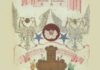
Elements in the image in Gems image are clearly reflected on page 12 of the Secret Symbols (1785-1788 Altona version), which instead bears the title ‘Mysterium Magnum Studium Universali’. Rather than green and red, however, the eagles are gold and silver, accompanied by symbols representing their white and red tinctures. The three alchemical principles appearing on the eagles have remained the same, yet the image also shows an image of Christ within a hexagram, flanked by angels and with a cross of the ‘Gold and Rose Cross Brother’ hanging below. The cross contains inscriptions of faith, hope, and patience. Further inscriptions upon it are ‘Magister Iesus Christus D et H’ and ‘Benedictus Dominus Deus Noster qui dedit nobis Signum’. ‘D et H’ could likely stand for ‘Deus et Hominem’, thus indicating ‘ Master Jesus Christ, God and Man’. The latter phrase in Latin means ‘Blessed be the Lord our God who has given us our Symbol’. This Cross replaces the equal-armed cross pattée hanging below the eagles in the Gems illustration.

Another illustration showing the image of a tree appears on page 4 of Gems of Wisdom, titled ‘Baum der Erkandtnus gutes und böses’ (Tree of knowledge of good and evil). It shows a winged figure in the form of a sphere with a band of the celestial equator and two arms reaching up to pull fruit from the tree. The fruit on the left side is numbered 1 – 7 while the fruit on the right side remains unnumbered. A hand from heaven reaches down, touching the top of the tree. A pair of circles at the roots of the tree appears, with ‘faith’, ‘love’, and ‘obedience’— three pillars in the kingdom of God—surrounding the sides of a triangle. The other shows a serpent in a downward-pointing triangle in the realm of chaos.
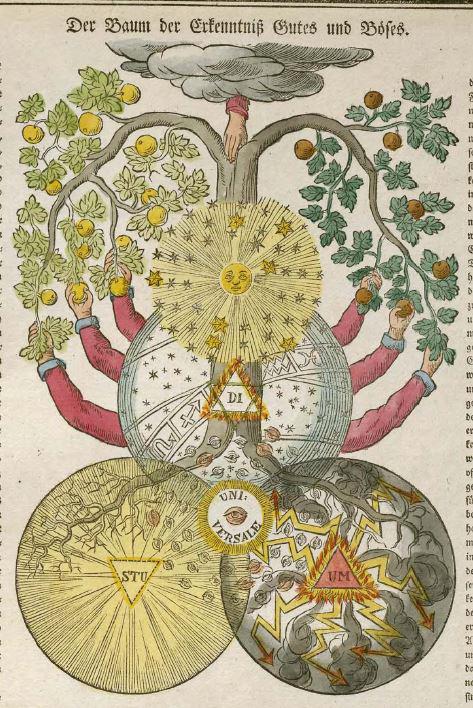
Undoubtedly, this image corresponds to the illustration on page 49 of the Secret Symbols, where it is also referred to as the ‘Tree of knowledge of good and evil’. The image, however, is slightly different than the one in Gems. Rather than a winged sphere with arms, the celestial sphere in the Secret Symbols is flanked with six arms that reach up to grasp the fruit on the tree. The fruit on the left side of the tree is light, while on the right side it is dark. There are again two spheres at the bottom, except they don’t spell out the same message as in Gems. All three spheres in the image together spell out the words ‘Studium Universale’.
The words, as well as the image itself, appear to be an exact reproduction from Valentin Weigel’s Studium Universale, first printed in 1618 (seen here). Although the image in Gems of Wisdom appears slightly different, its inclusion with the others later to be found later in the Secret Symbols establishes its placement as a likely influence.
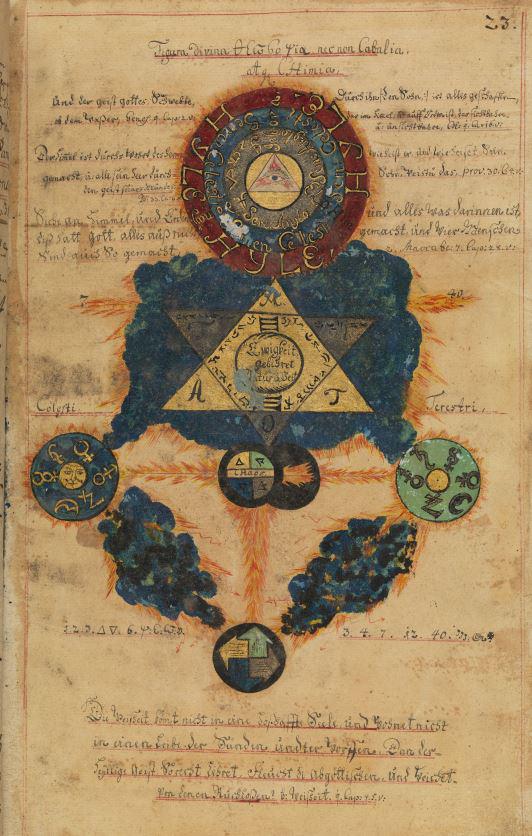
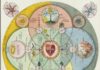
On page 23 of Gems, a diagram with several circles and a hexagram is titled ‘Divina Theosophia nec non Cabalia’ (The Divine Theosophy as well as Cabala). There are also several circles with various titles on the page. The top sphere is labeled ‘Hyle’, a reference to Aristotle’s term for ‘primal matter’. Within it are the concentric circles labeled ‘Semen Celesti’ (seed of heaven), another is “Sem: Anglo:” (an unknown abbreviation, likely in Latin), and a triangle at the center with the eye of providence, corresponding to the words ‘Jehovah’, ‘Elohim’, and ‘Adoni’ at each of its three points.
Inside the hexagram are the words ‘Ewiegheit, gebieret natur und zeit’ (Eternity, death, nature and time). Four points of the hexagram contain letters that spell out the word “FIAT”. The remaining two at the top and bottom respectively showing ‘A’ and ‘O’ for the Alpha and Omega. Other spheres shown contain the alchemical symbols for the planets. One circle is marked ‘colesti’ (‘the heavens’, ‘divine’, or, ‘of the gods’) with the other labeled ‘terestri’ (earth). Between these two is a circle marked as ‘chaos’, containing symbols for the four elements. At the bottom is another circle with four arrows pointing in four different directions, likely referencing the four elements generating within the lower world.

Page 14 of the Secret Symbols reveals some of the same symbolism, but several things have been changed or added. The title now is ‘Figura Divina Theosoph. Philosoph. Cabalist. nec non Magica & Chymica’ (The Divine Figure of Theosophy, Philosophy, Cabala, as well as Magic and [Al]chemy. Many of the circles have received additional labels, or, entirely new ones have appeared. At the bottom, where there was originally a circle with four arrows representing the elements within the earth, there are now several spheres depicting several stages of alchemical processes.


Other pages showing similar illustrations between the two books include page 44 of Gems where a book with 7 spheres is shown containing a list of important biblical numbers. Page 34 of the Secret Symbols shows a similar book titled ‘The Earthly Book of Seven Seals‘ with additional symbols appearing in the margins.


Page 3 of Gems shows another illustration titled ‘Der baum des Liebens’ (The Tree of Life). A small diagram labeled ‘Lumen Nature’ and ‘Lumen Gnaden’ (Light of Nature & Light of Grace) can also be found on page 7 of the Secret Symbols.
The Virgin Sophia

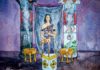
Perhaps the most striking image found in Gems of Wisdom and Prudence though is the illustration found on page 52 titled ‘Jungfrau Sophia Die Himmlische Und Irdische Eva/ Die Mutter aller Creaturen’ (Virgin Sophia The Heavenly And Earthly Eve/ The Mother Of All Creatures [or Creation]). Here, the Virgin Sophia stands atop a circle containing the Earth, the Moon, and the Sun within its radiating bands. In her womb is the ‘Figura Divina’ (Divine figure) and at her sides, she is flanked with possibly the four remaining classical planets. Within the sphere’s bands are twelve symbols, suggesting alchemical operations which correspond with the zodiac. She wears a crown and holds a wand in her right hand. In her left hand is a sphere labeled ‘Archus’ with ‘Luft’ (Air), ‘Feuer’ (Fire), ‘Erde’ (Earth), and ‘Wasser’ (Water).

The image is obviously reflected on page 29 of the Secret Symbols. There, however, Sophia has substantially changed form. Her face is the Sun and her crown is made of stars. She still carries a child in her womb, but instead of just four planets or elements, there is a multitude of permutations in the spheres beneath her. These represent elemental, alchemical, and mystical states. The Earth, planets, and zodiac have been broken down and shown in several forms.
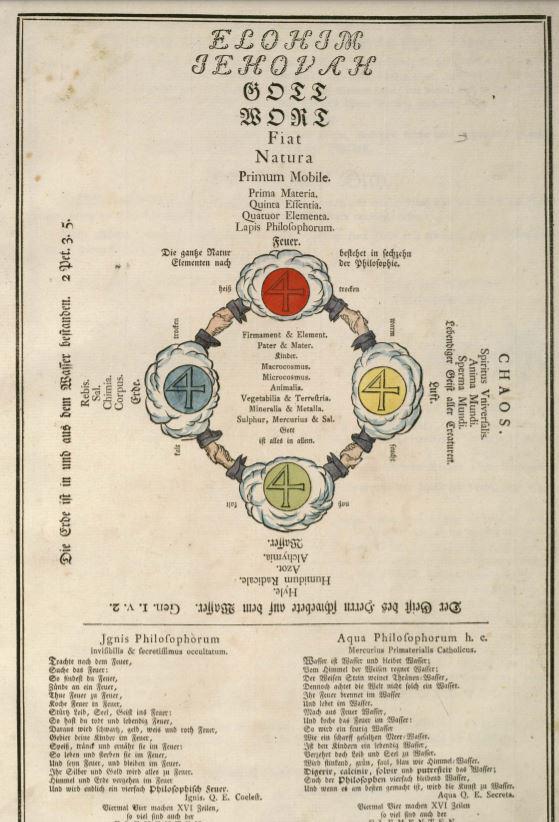
The sphere that Virgin Sophia holds in her left hand in Gems also appears in a different image in the Secret Symbols. On page 6 of the latter, the shape with four elements (‘4s’) has been broken down into further designations.
The story of how the images made their way from Gems of Wisdom and Prudence to the Secret Symbols of the Rosicrucians of the 16th and 17th Centuries is still unknown. However, it becomes increasingly clear after reviewing these in addition to those found in the D.O.M.A. manuscripts that the authors were looking at more than one source as inspiration for the Secret Symbols. The illustrations of Gems certainly appear as a set that could belong to this list of sources.
Bibliography:
Gemma Sapientiae et Prudentiae
Wellcome Library MS 2492, c. 1735
Geheim Figuren der Rosenkreuzer aus dem 16ten und 17ten Jahrhundert
J.D.A. Eckhardt, editor/publisher. Commissioned by the Heroldschen Buchhandlung, Hamburg
1785-1788, Altona, Germany
https://archive.org/details/GeheimeFigurenDerRosenkreuzer1785