Self-Initiation is Possible
Back in the summer of 2020 I shared the first part of my journey of Self Initiation Into the Rite of Memphis Misraim. I completed the First Degree self-initiation on December 27th 2019, and the Second Degree on June 24th 2020, primarily with the self-initiation rituals set out in Jean de Biasi’s book Esoteric Freemasonry. In this blog post, I share my experience of self-initiation into the tomb degree.
 Originally, I was inspired by Sam’s epilogue to Milko Bogard’s book On Memphis and Misraim, but had become increasingly frustrated by the geographical inaccessibility of MM lodges and the lack of response from those MM bodies whom I had approached with enquiries. I did eventually receive responses from several groups, and have been in consistently in communication with one particular Order since that time…. Then along came a global pandemic which has put a hold on all in-person initiations into that group. The solution; continue my self-initiation workings into Egyptian Masonry.
Next Step: Facing the Third Degree Initiation
I decided to go ahead with the Third Degree self-initiation, partly for the sake of completion, and partly because I had learned so much about the Rite during the interim that I really wanted to do some personal work on it. However, much of what I had learned had left me conflicted with regard to my original understanding of the rituals and teaching as laid out in de Biasi’s book.
For example, in response to my original article, one respected member of the Rosicrucian Tradition group described the book as “inaccurate and misleading”, whilst the Heirophant of an Order that I had been in contact with had remarked upon its Pagan overtones. To my surprise, I also had a number of very supportive emails from regular masons who were interested undertaking those self-initiations themselves. My response to this was “do it, but don’t do it the way I did.”

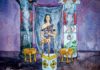
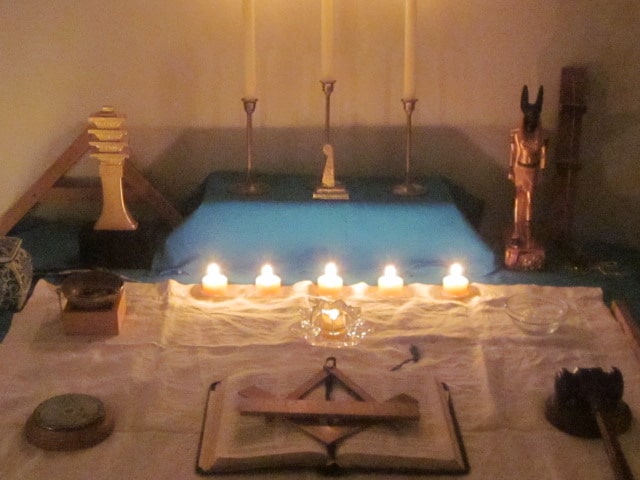
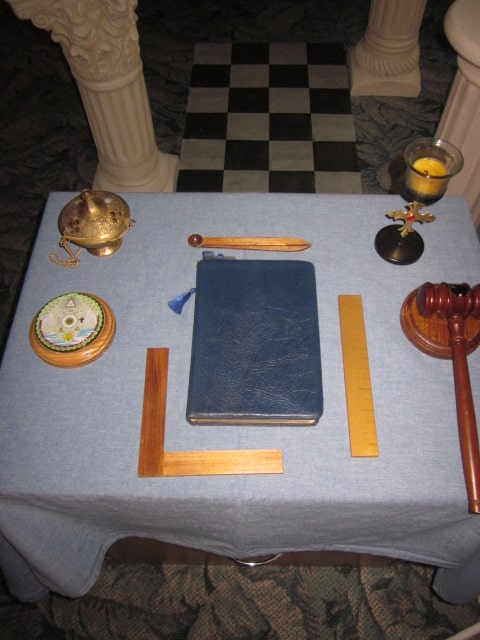
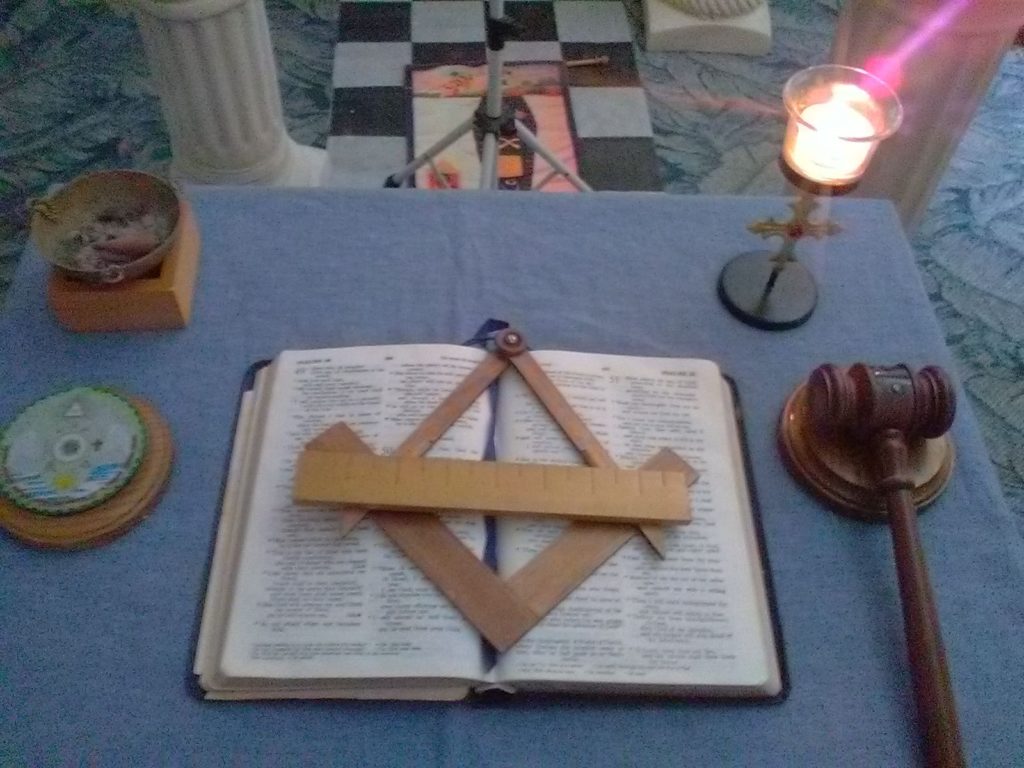
All images are from Graham’s third degree working
Whilst I personally found de Biasi’s book offered an intriguing historical perspective and a useful framework for rituals, I had to reconsider using the rituals from the book verbatum in light of what had been said by these esteemed Brothers. Much light was shed on the subject when I obtained and read Spirit Builders by Tau Palamas, and Mathieu Ravignat’s recent book, Quest for a Lost Rite: The Origins, High Degrees and Spiritual Practices of Traditional Egyptian Freemasonry; two entirely divergent (but in my case complementary) expositions of the Egyptian Rite.
There was a more personal issue to consider; as a monotheist myself, I had become more than a little uncomfortable with the heavily Khemetic nature of de Biasi’s liturgy. The fact that Ancient Egyptian Gods are mentioned was not the problem; it is, after all, a definitively Egyptian Rite. My concern was with the emphasis on the veneration of the Egyptian gods and goddesses in relation to the Supreme Architect of the Worlds.
Whilst I truly respect the position of religious Khemetics, who tend to believe in and worship the gods and goddesses of Ancient Egypt, I felt that I personally had to modify the ritual to accommodate my own monotheistic/traditionalist perspective, by placing emphasis on the transcendence and centrality of the Supreme Architect, and viewing the Egyptian pantheon as aspects of Deity.
This also required a paradigm shift on my part. I moved from seeing the issue as Paganism/Polytheism vs Monotheism, to an acceptance of the Ancient Egyptian pantheon in terms of mythos, metaphor and allegory. These gods became, for me at least, archetypes, and the whole ritual a drama played out in order for me to be able to connect with whatever unconscious parts of my psyche they represent.
“To say the ancients believed in Greece in the loves of Jupiter, or adored in Egypt the cynocephalus and the sparrow hawk as living and real gods, is to be as ignorant and as in bad faith as one claiming that Christians adore a triple God consisting of an old man, a torture victim, and a pigeon.” Eliphas Levi. The Doctrine and Ritual of High Magic.
The Unexpected Turn
Then, wouldn’t you know it, things took a peculiarly serendipitous turn (as they do)…
Sam had asked my in an online conversation if I had any intention of undertaking the Abramelin Operation. I replied that I had no such intention, and that I would consider something less ambitious but in a similar vein. Shortly afterwards, I came a cross a slim volume titled The Osiris Scroll by Nick Farrell.
In his foreword, Nick explains that he wrote this series of around pathworkings based upon the Book of Coming Forth Into the Light (aka The Egyptian Book of the Dead), with the intention of its being used “as a self-initiation system similar to the Book of Abramelin the Mage.” Not only did I find this affirming, but I was challenged by his warnings that this was not a practice for the beginner, and that it was formulated with the adept in mind. Nick also cautions that many who had undertaken the pathworkings in the book had experienced health crises as a result. Furthermore, the progression of the text through its several series of gates seemed compatible with and even complimentary to de Biasi’s self-initiation ritual.
The Ritual Preparation
I resolved to complete the entire series of pathworkings from the Osiris Scroll. Nick Farrell recommends recording the guiding narratives through the gates of his text and replaying them in a meditative setting. It has often been said that to the Ancient Egyptians, Heka (magic) was a technology. To this end I recruited some pretty ancient technology of my own – a Sony Walkman, which I had cherished as a (now vintage) keepsake from my own college days. Traditional Egyptian ritual incense (Kyphi) was also an important part of the process, and helped to intensify the atmosphere of the succeeding rituals.
The Big Day
The process of self-initiation extended over several months of preparation and progressive visualizations up to the point when the Big Day came. It was an elaborate set-up, and I had introduced a lot of my own material implements in addition to modifying de Biasis’s text as I had explained earlier. These included a home-made Djed pillar, and ankh-headed staff, a Feather of Ma’at, a ceremonial sword, and a small statuette of Anubis. One nice textual inclusion was the reading aloud of “The Eight Ma’ats”, which I gleaned from Sharon Laborde’s Khemetic Independent website.
The climax of the ritual was the role-play of the death and resurrection of Osiris in a similar way to that of Hiram Abiff in the regular Masonic Third Degree Ritual. This was accomplished with a the aid of black funerary shroud on which was emblazoned the traditional insignia of the degree, and a replica scarab amulet (a traditional Phareonic funeral accessory), and of course, my trusty Sony Walkman.
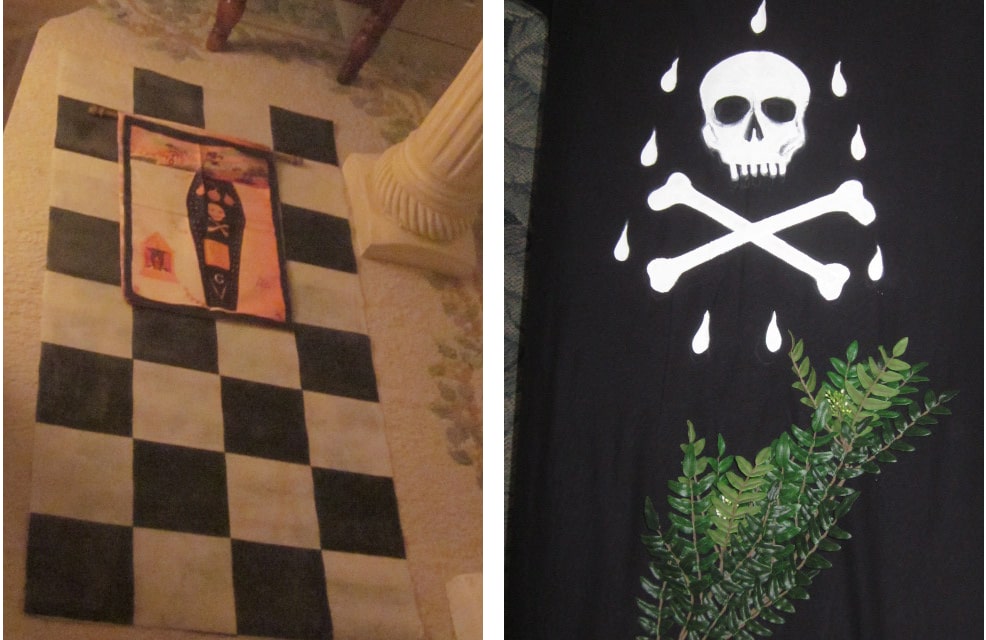
It is hardly possible to convey a sense of how the ceremony felt, although I did occasionally pause to take a few snapshots at strategic junctures, in anticipation of sharing this experience on this blog.
Imagine, if you will, being in a small room at the farthest periphery of an empty (non-residential) building, temporarily converted to all intents and purposes into a microcosm of a mesocosm (i.e. a tiny masonic “lodge”), complete with chequered carpet, pillars, altars, luminaries, fixed and mobile “jewels” etc.. The air hangs heavy with the aroma of exotic and unfamiliar incense, and in the background the strains of masonic ritual music by Francesco De Megni. While I tried to remain focused on the correct recitation of the liturgy (and I confess to occasionally becoming distracted and referring to previously prepared crib cards), I also imagined the presence of the Masonic and Rosicrucian Masters and Brethren whom I had called into my field of awareness at the beginning of the ceremony (I would no longer describe so elaborate a process as a “ritual” at this point).
I was surprised to discover afterwards that the ceremony proper, including opening and closing of all three degrees, took only about 90 minutes in total; perhaps because I had been rehearsing it on a weekly basis for the previous six months or so, and I had memorized key parts of it by heart.
After Thoughts
I had intended to write up my experience for the Pansophers blog fairly promptly after the completion of the ceremony, while it was still fresh in my mind, but Sam recommended I wait at least a couple of weeks in order to process the information, and I agreed that was pretty sound advice.
So what can I say about the process of self-initiation? Well, firstly, I would probably never have gone to such a considerable amount of time and trouble if a viable alternative had been available. (I should remind readers that I was specifically interested in Memphis Misraim Masonry, and that although regular Masonry was accessible to me, it would not have served my purpose to join a local Blue Lodge.
The second point is that although I began the process pre-Covid, the continuing initial lockdowns and continuing concerns further limited any opportunities for in-person initiation with the particular group that had contacted me and accepted my petition. It was partly for these reasons that I decided to continue with the second and third initiations, and also because having begun to work with de Biasi’s system, I felt a need to see it through to completion and closure.
In a sense, it was like having started one of those Anatomy Coloring Books; you keep coming back to it, and unless you finish it and move on, it lies around the house forever and will always wish you had. That said, I realize that completing the rituals in a self-initiation workbook no more makes one a Mason than completing an Anatomy Coloring Book made one a doctor. But it did give me the impetus to research the material and learn, on many levels beyond the mere intellectual.
I also overcame a deep cultural aversion to an ancient and venerable belief system and learned that taking center stage in a mythical drama set in the cultural and historical backdrop of that system does not demand an abrogation of my own religious and spiritual landmarks. In fact, it brought a greater clarity and a broader perspective to my own long-established beliefs. It has also greatly informed my understanding of the relationship between the Ancient Egyptian Mysteries, Freemasonry and Rosicrucianism.
As I write this, over a month later, I continue to ponder the effects it has had on my spiritual progress. I think that I have tried to go about my daily life consciously aware of moral and ethical commitments that I undertook as part of the initiations. In a sense, I try to live as if I were indeed a Mason. For example, I feel a stronger obligation than ever to engage in service to my community, and to contribute to worthy charitable causes; so it’s not all about me – it has positive repercussions out into the world.
In addition, I have kept to a regular twice-monthly schedule of “working rituals”, which involve opening and closing the degrees in my sanctum, and engaging in some relevant meditations, pathworkings or readings from various masonic sources.
Finally, would I do it again? Well, hopefully, I won’t have to, but I’m glad I did. That doesn’t mean I am not still interested in joining a Memphis Misraim lodge once the pandemic is over and the opportunity arises; but in the meantime I have been able to discover so much more about the vast subject of Egyptian Freemasonry than I ever may have done.

Our Pansophers community is truly inspired by this reminder to just go ahead and do the work. On behalf of our community, thank you Graham for this beautiful article and for sharing your photos!!